Showing posts with label Whales. Show all posts

Monday, September 30, 2024

Navy: Targeting Ka'ula Island bird refuge weekly with bombs and guns would only result in "incidental" take

 The Navy’s new proposal to expand bombing and gunnery practice at Ka’ula Island seems insupportable, both morally and as a matter of federal law.

Here is the Draft Environmental Assessment that includes the Ka’ula impacts.

It expands potential military operations at the tiny island to 55 per year, more than one a week. That is on an island that is a designated state seabird sanctuary (established 1978) and contains endangered and state and federally protected plants and birds, and marine protected species in the nearshore waters.

Ka’ula is one of the four islands of of Kaua’i County (Kaua’i, Ni’ihau, Lehua and Ka’ula). The designated weaponry impact area is 11 acres at the southern end of the 130-acre island.

Ka’ula is well known in Hawaiian history and chant. The bird life there was once so dense that the island was used as an example of overcrowding. 

(Hā’iki Ka’ula I ka ho’okē a na manu. There is no room on Ka’ula, for the birds are crowding. –from ‘Ōlelo No’eau by Mary Pukui.)

It has been bombed since 1952.

The Navy over the years has steadfastly resisted calls to end its bombing, from fishermen, from U.S. Congress members, the U.S. Secretary of the Interior, from the Kaua’i County Board of Supervisors (1961) and Kaua’i County Council (1975), and from federal fisheries and wildlife officials.

And from the State of Hawai’i, whose attorney general in 1978 asserted the island belongs to the state. That conflict over ownership was not resolved, and state officials now say the ownership is contested but no recent efforts to assert state control have been reported.

Weapon strikes are proposed to be limited to the designated 11-acre “impact area.” But that has not always been the case: 1) A 1978 fisherman’s report saw bombs exploding both in the water and among seabirds; 2) The Draft EA says there are likely live munitions on the island outside the impact area; 3) On one occasion in 1965, bombs intended for Ka’ula landed on Ni’ihau, more than 20 miles away.

The new proposal says only inert weapons will be deployed in the future.

The birds and seals of Ka’ula, as well as passing whales and dolphins, are protected by the US. Migratory Bird Treaty Act, the U.S. Marine Mammal Protection Act as well as the island’s designation as a State of Hawai’i bird refuge.

The Draft EA proposes that the impact of bombing, gunnery exercises, helicopter landings and other activities are acceptable. There are Hawaiian cultural sites, including stone temples and habitation sites, but they are outside the designated impact zones and so, “impacts on cultural resources would be less than significant.” (Page 3-86)

The Navy’s legal justification for harming wildlife is contained in a federal law, the 2003 National Defense Authorization Act. It “gave the Secretary of the Interior authority to prescribe regulations to exempt the Armed Forces from the incidental taking of migratory birds during authorized military readiness activities,” the Draft EA says.

Based on that, the Draft EA argues that targeting a wildlife refuge and protected bird nesting site with bombs, shells and landing helicopters would result in takes that are merely incidental. The Draft EA says (Page 3-30) that the Department of Defense has a responsibility to minimize and mitigate its impacts. But it seems at least problematic to argue incidental and minimized when the wildlife refuge is the target.

The Draft EA argues that health, safety and noise are not issues because there are “no human sensitive receptors” nearby. This, of course, does not address the impacts on the health, safety or hearing of protected sooty terns, threatened black-footed albatross or endangered Hawaiian monk seals.

The Navy asserts that it owns Ka’ula. That position has long been challenged by Hawai’i.

The island was set aside by the Territory of Hawaii for use by the U.S. Department of Commerce under the U.S. Lighthouse Service in 1924 as a lighthouse reserve. Commerce conveyed it to the Coast Guard, which operated a navigational light there until 1947, when it was permanently shut down.

Instead of returning the island to the territory, the Coast Guard in 1952 authorized the Navy to conduct bombing exercises, apparently without the authorization of territory. 

Kaua’i County residents began regularly protesting the activity within a few years, at the behest of anglers who said the bombing was impacting birds, which the fishermen depended on to locate schooling fish.

U.S. Rep. Patsy Mink in the early 1960s urged the island’s inclusion in the Hawaiian Islands National Wildlife Refuge, and the Department of Interior started but failed to complete that inclusion.

The Navy rejected the Hawaiian ownership arguments, and in 1965, U.S. Rep. Spark Matsunaga reported that the Coast Guard had transferred its authority over the island to the Navy.

The comment period for this Draft EA is ending. Comments go to pmrf-lbt-ea-comments@us.navy.mil.

© Jan TenBruggencate 2024
Saturday, February 11, 2023

Have we already seen peak humpback whale populations? Maybe.

 Long-time Hawai’i residents have seen the remarkable increase in humpback whale numbers since the 1960s, but that increase could be over.

Whale numbers dropped catastrophically in the middle of the last decade, and there are suggestions that climate changes mean we may have already seen peak whale numbers. 

Although whales are impacted by lots of things, including entanglement with marine debris, swallowing marine debris, overfishing of prey resources and other issues, the key threat may be reduced food availability associated with a warming climate.

A little background.

The numbers of humpback whales got so low that the International Whaling Commission banned humpback hunting in 1966, although a couple of countries continued hunting them for several more years. They were placed on the Endangered Species List in 1970. 

In 1992, the Hawaiian Islands Humpback Whale National Marine Sanctuary was established to add protection to the Hawaiian Islands breeding grounds for the central North Pacific population of humpbacks. 

Today, there are close to 100,000 humpbacks alive globally, living in 14 identified breeding groups that do not often interbreed. At the peak population, before whaling, there may have been 125,000 to 150,000. See this source.

Around Hawai’i, at their lowest, in about 1965, there were only a few hundred animals. Hawai’i residents back then would spot an occasional spout, but nothing like the great shows of spouting and slapping and leaping that we see commonly today. Today the Hawai’i humpback whales number about 12,000 in the Islands.

The animals summer in their feeding grounds off Alaska, where they feed on the huge schools of small fish and krill, a shrimp-like creature. The whales that come to the Hawaiian Islands winter in shallow coastal waters, where they give birth, mate, and feed their young, but do not eat much. They rely on the fat stores from all that krill they have eaten during the summers up north.

But after decades of increase from their low numbers in the 1960s, the whale numbers stumbled 10 years ago, particularly from 2015 to 2016.

“Numbers then declined, including a precipitous 60% drop between 2015 and 2016,” wrote Adam Frankel, Christine Gabriele, Susanne Yin and Susan Rickards, of the Hawai’i Marine Mammal Consortium in Kamuela.

It seemed to have been linked to warming waters in the feeding grounds. An extended warm period described as “the largest marine heatwave event ever recorded in the Northeast Pacific Ocean” started in late 2013. It caused serious disruption to the ocean ecosystem. These authors didn’t know exactly how that impacted whales, but they suggested that the temperature changes impacted the food web, reducing humpback feeding success.

They are not alone. The authors of this 2022 paper said that North Pacific Heat Wave was associated with fewer surviving female whales, fewer calves, and a lower survival among those calves that were born.

“Calf survival dropped tenfold,” the authors said, and older animals also were impacted. They said “documented changes to the forage fish and zooplankton prey base” were the likely suspect.

Now, a new paper seems to confirm that hypothesis—although in the Antarctic rather than the North Pacific. It was published last month in the journal Global Change Biology, under the title “A surplus no more? Variation in krill availability impacts reproductive rates of Antarctic Baleen Whales.” 

The authors found that “krill availability is in fact limiting and affecting reproductive rates” and that humpbacks “may be at a threshold for population growth.” They said similar issues are occurring with several species of whales, as krill numbers decline in their traditional grounds, and some of them move to different parts of the sea.

That heat wave of a decade ago ended. But researchers say such heat waves have been increasing and are going to be happen more often. And that’s not good for the humpback population.

“Climatic extremes are becoming increasingly common against a background trend of global warming. In the oceans, marine heatwaves—discrete periods of anomalously warm water—have intensified and become more frequent over the past century, impacting the integrity of marine ecosystems globally,” wrote the authors of the 2023 Annual Review of Marine Science.  

These marine heat waves, the authors write, “are emerging as pervasive stressors to marine ecosystems globally.”

© Jan TenBruggencate 2023

Thursday, February 2, 2023

Plastic pollution is inescapable, and it contributed to the death of our sperm whale


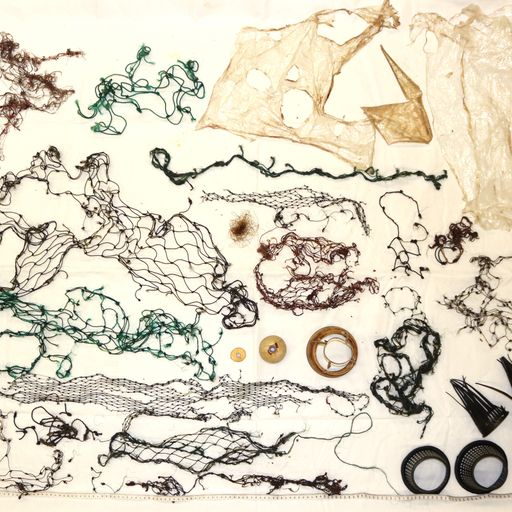
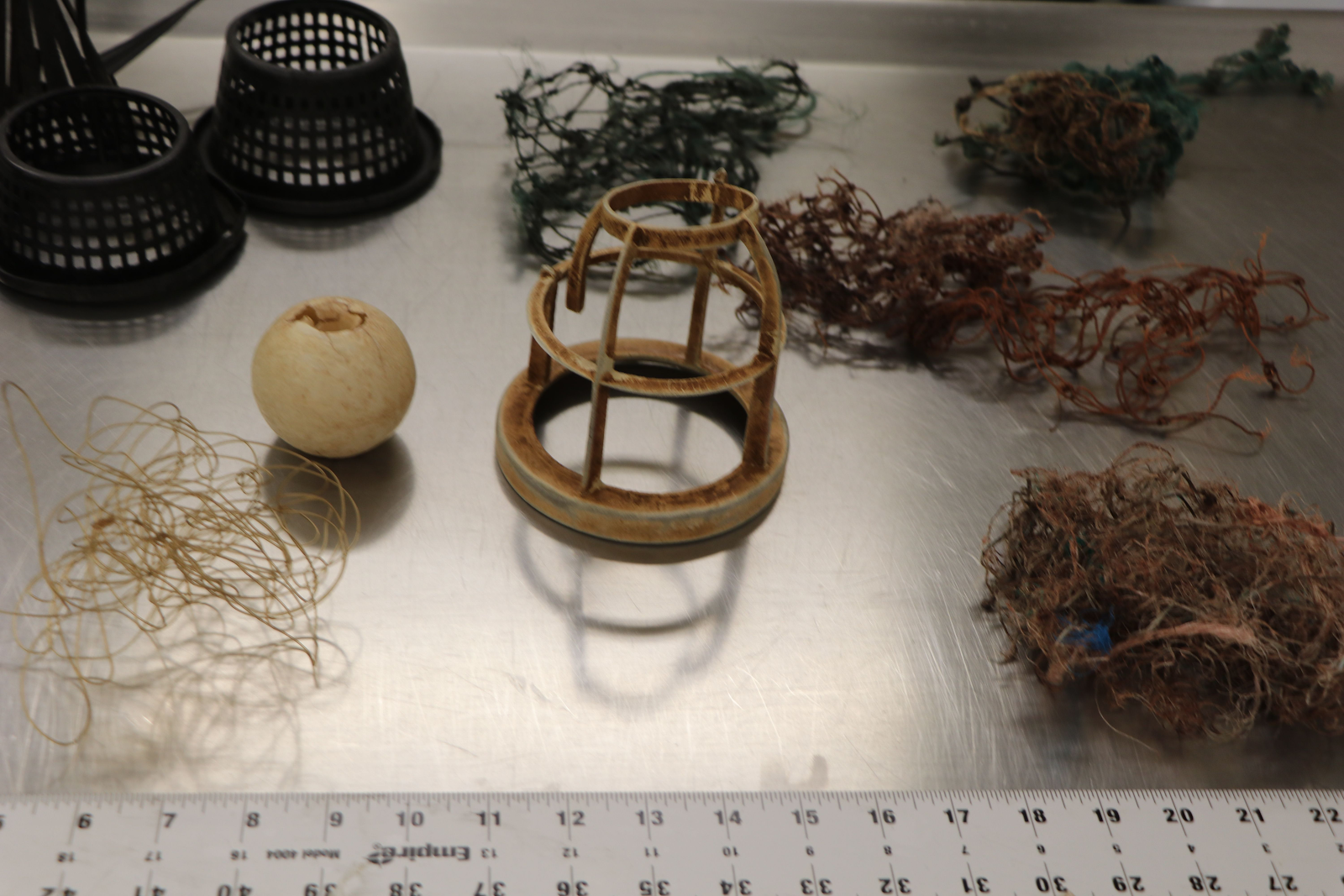
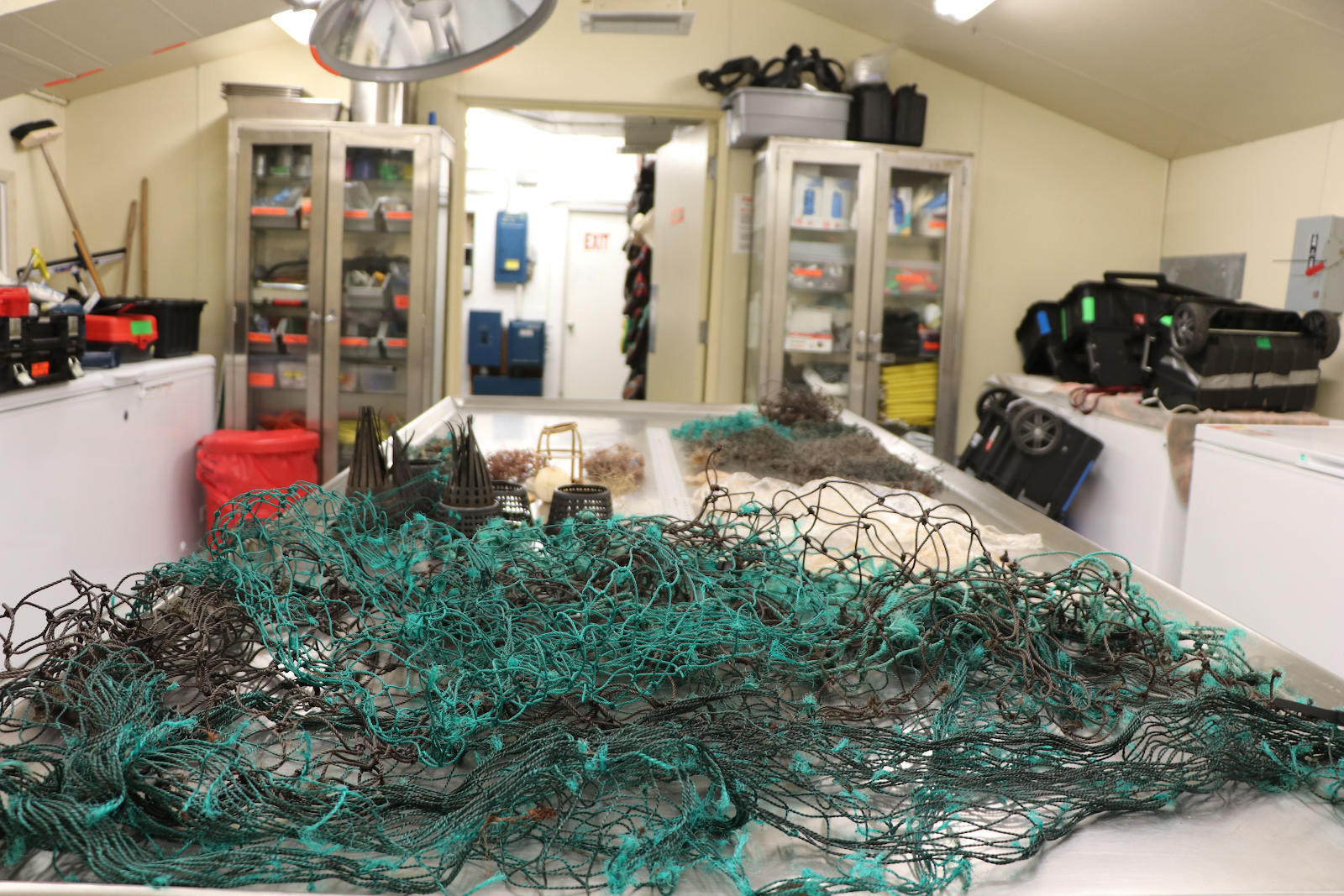
(Images--above and at bottom--of marine debris from sperm whale belly, courtesy UH Health and Stranding Lab.)

If you’re a fish or a turtle or most any kind of marine life feeding in the Pacific, it’s hard to avoid the plastic.

Almost all of the sea’s creatures end up ingesting some of it, and that includes the massive (56 feet, 50ish tons) sperm whale that washed up at Lydgate Park last week.

The Ocean Cleanup estimates 5 trillion bits of plastic in the ocean. 

And 1.8 trillion bits in the Great Pacific Garbage Patch, that vast gyre that runs roughly between Hawai’i and the Aleutians and California. 

The World Economic Forum estimates the ocean has 75 to 199 million tons of plastic. 

So if a critter opens its mouth to take a bite of food, it’s hard to miss getting some plastic as well.

And they do.

There are microplastics in squid. 

Plastics in all species of marine turtles. 

Plastics in tuna, including canned tuna meat. 

Plastics in many kinds of seabirds. 

The Maritime Aquarium in Connecticut estimates that by 2050, the way we’re going, there will be more plastic in the ocean than fish.  

So, no surprise when an adult sperm whale washed ashore dead last week, it had a bellyful. Of plastic.

“A major finding was the number of manufactured items in the whale’s stomach,” said Dr. Kristi West, director of the University of Hawaiʻi at Mānoa Health and Stranding Lab. It could have been enough plastic to cause a blockage, and could have contributed to the whale’s death, West said.

In addition to squid beaks and fish skeletons and other natural food remains, they found chunks of plastic netting, plastic bags, bits of rope, monofilament fishing line, a fishing net float, and several of the odd cone-shaped black plastic devices that are the doors to hagfish traps.

This is shocking, but it isn’t news. Whales of many species, including sperm whales, have been stranding all around the world with plastic in their guts. And the filter-feeding Humpback whales that seasonally slap and leap around Hawai'i are not exempt, although they tend to ingest tinier bits of plastic. 

The study into the cause of the Lydgate  whale’s death will continue with laboratory analysis of organ and other body parts, and it may be a long time before a firm cause of its demise is established, if it is.

And as for the plastics, where does it all come from? Certainly a lot from fishing operations—some of the ropes, and monofilament, and nets, and hagfish traps and plastic floats. But it’s estimated far more comes from the land—blowing off the shore, sluicing down storm drains and, the biggest source, washing down big rivers.

© Jan TenBruggencate 2023


Sunday, January 29, 2023

Why did the sperm whale die? That's not yet clear, but myriad possibilities

 It will likely be weeks or longer before we know why a big sperm whale washed ashore on Kauai, or we may never know.

Some folks have already been suggesting theories, but without doing the science, it’s guesswork.

There are many known causes of sperm whale strandings—many natural and some involving human activities.

Veterinarians and other wildlife experts are doing the hard work to conduct a necropsy on the more than 50-foot sperm whale that washed up at Lydgate Beach Park in Wailua, Kaua’i, on the morning of January 28.

But let’s look at some of the possibilities.

Whales do get old and die. They get viruses and other diseases. They can be affected by parasites. There is some evidence that climate change can impact navigation and food availability. They can be injured by natural (think big sharks) or human (think container ship impacts) causes. Noise can disorient them, and that noise can be from natural causes like undersea earthquakes, or human causes like deep sea mining exploration, sonar and noisy big ships.

The options really are too numerous for guesses to be taken seriously. Some recent strandings have had various causes.

One sperm whale that beached in the Florida Keys last year was very thin. On investigation, it had ingested marine debris, which had interfered with its ability to feed.

A 30-foot sperm whale that washed up this month in Oregon had injuries consistent with being hit by a ship.

This 2018 study suggests that some North Sea strandings may simply have been because the healthy but young sperm whales inadvertently swam into shallow water and couldn’t get back into the deep. 

Sperm whales, like many others, can become engangled in marine debris like ropes and buoys, and can be weakened by having to drag all that weight. Entanglement in fishing gear like buoys can make it difficult for whales to submerge for feeding.

This 2005 study and this 2009 study suggested that sunspot activity and even changes in the Earth’s magnetic field could impact sperm whale stranding. 

As we reported recently at Raising Islands, roughly half of recent stranded whales of various were associated with a newly described virus. 

In some cases, there are multiple things going on, such as skin disease, liver disease, parasites, viral infections, bacterial infections, fungal infections, high concentrations in blubber of man-made chemicals like pesticides and PCBs, and having ingested plastic while feeding. In many cases, it is not possible to determine which, if any, of these was the cause of the stranding.

And then there is the whole issue of climate change, which can impact marine life in numerous ways, including forcing animals into unfamiliar feeding territories, impacting feeding for juvenile animals, and much more. This Australian study from 2013 suggested: “Reductions in the extent of key habitats, changes in breeding success, a greater incidence of strandings in dugongs and cetaceans, and increased exposure of coastal species to pollutants and pathogens are likely.” 

In one month last year, 17 whales of several different species stranded off Norway. The cause is not known, and as the authors of this paper wrote, “Whale strandings are common globally, although to date there are still many challenges in identifying their cause.” 

© Jan TenBruggencate 2023

Saturday, January 28, 2023

Sperm whale strands on Kaua'i's Lydgate Beach at Wailua


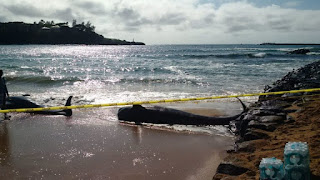
An adult sperm whale washed ashore early today (Saturday, January 28, 2023) at Lydgate Park in Wailua, on Kaua’i.

The county issued a press release urging people to stay away from the popular beach park while government agencies respond to the incident.

The marine mammal appeared by initial estimates to be more than 50 feet in length, and could weigh 30-45 tons.

The whale was reported visible on the reef off the beach park Friday afternoon, apparently already dead. By morning it was washing in the shorebreak. Government officials were working to determine how to deal with the animal.

Sometimes dead marine mammals are brought ashore for burial. Sometimes they are towed out to sea. And occasionally, particularly when they are in remote locations, they are left to decompose in place, where they become a major food resource for crabs and other coastal marine life.

However, Kaua’i County’s Lydgate Beach Park is hardly a remote location. It gets hundreds of visitors daily for its white sand beach, protected swimming area, pavilions, playground, tennis courts and more. The whale carcass was roughly in the middle of the beach fronting the park, about 1,500 feet south of the mouth of Wailua River.

No cause of death has been determined, but National Oceanic and Atmospheric Administration personnel, along with state Department of Land and Natural Resources personnel, will conduct a necropsy to gather evidence.

In a 2017 stranding of five pilot whales at Kalapaki Beach, about six miles south of Lydgate, the animals were removed to a remote island location, where necropsies were conducted before burial of the whales.

Sperm whales are found regularly in the deep waters off the Hawaiian Islands and the rest of the Pacific, and they were a key target of the whaling fleets that operated around the Islands during the early 1800s. There have been sperm whale strandings on several Hawaiian Islands.

In December 2021, an adult sperm whale washed ashore at Pila’a, Kaua’i, about a dozen miles north of Wailua.

Whale strandings and deaths have been linked to disease, parasites, impact injuries from watercraft and other causes, but the cause of many strandings is never determined.

Newsweek earlier this month reported an unusual increase in marine mammal strandings recently, including two sperm whales and seven humpbacks in the North Atlantic since December. 

NOAA Fisheries reports that on average, there are 20 strandings of whales or dolphins in the Hawaiian Islands in any given year. 

Just this week, researchers at the University of Hawai’i and NOAA reported on a newly discovered virus that was found in the tissues of 15 of 30 tested cetaceans that died on beaches in Hawai’i, Samoa, Saipan and at sea. It is not clear that virus was the cause of death in any of these cases, but it has the capacity to cause significant illness in some dolphins and whales. We reported on that in an earlier blog. 

Sperm whales are the largest of the toothed whales, with adults ranging from 40 to 52 feet in length. The Lydgate whale appears to be at the upper end of that range. They can range in weight from 15 to 45 tons, according to NOAA Fisheries.

They are found throughout the world’s oceans, and while their population has increased significantly from the heavy whaling years, they continue to be listed as endangered under the U.S. Endangered Species Act and depleted under the Marine Mammal Protection Act. They are now protected throughout their range.

NOAA estimates that more than 400,000 sperm whales were taken between the start of whaling in 1800 and its end in 1987 in the North Pacific alone, and more in other oceans. 

A study reported last year in Nature estimates that the pre-whaling global population of sperm whales approached 2 million, that it was severely depleted by whaling, and that in 2022, the number had grown back to around 850,000. But the study said those estimates are very uncertain.

© Jan TenBruggencate 2023

Thursday, January 26, 2023

New clues in Hawai'i whale strandings


Whale and dolphin strandings are generally fatal to the marine mammals involved, but also traumatize their human cousins who attend them.

Often, researchers have been unable to figure out why the animals appear to commit suicide. Now there’s a hint of a clue.

Two of the pilot whales that stranded (image above) on Kaua’i’s Kalapaki Beach in 2017 suffered from a newly discovered virus that affected multiple organs.

It was October 13, when five pilot whales drove themselves onto the sand at the popular beach outside Lihue, and fronting what is now the Sonesta Kauai resort. People tried pushing the whales back into the sea, but often they swam or washed right back in. More whales from the same pod were herded away from the beach by paddlers and surfers, and appeared to have survived and left the bay.

They were short-finned pilot whales, Globicephala macrorhyncus.

 A new study of necropsy samples from numerous whale and dolphin strandings—on Kaua’i, O’ahu, Molokai, Maui, Hawai’i Island, as well as Saipan and American Samoa—shows that those two Kaua’I animals and many of the other stranded cetaceans were suffering from a newly discovered beaked whale circovirus.

The study was published today (Jan. 26, 2023) in the journal Frontiers in Marine Research. Its authors are Cody Clifton and Kristi West of the University of Hawai’i College of Tropical Agriculture and Human Resources and the university’s Hawai’i Institute of Marine Biology; Ilse Silva-Krott of Hawai’i Institute of Marine Biology; and Michael Marsik of the National Marine Fisheries Service in Pago Pago.

They call the virus an “emergent disease with unknown population impacts.”

The researchers studied archived tissues collected in necropsies of 30 individuals involved in recent Pacific strandings—including from the brain, kidney, liver, lung, spleen and lymph nodes. In many cases, the virus—identified through PCR testing—was found in multiple organs.

The tissues were being stored at the University of Hawai‘i Health and Stranding Laboratory.

“Of the screened individuals, 15 animals tested positive in one or more tissues, with a single striped dolphin (Stenella coeruleoalba) testing positive in all six tissues,” they wrote.

“Brain tissue was the most consistently positive tissue type (69%), followed by lymph tissue (67%) and lung tissue (64%),” they wrote.

It is not clear whether the viral infection caused or was directly related to the strandings, but it is a significant medical issue for marine mammals.

“Infectious diseases pose a major threat to cetaceans and (beaked whale circovirus) may represent an important emerging disease within populations spanning the central, Western, and South Pacific,” the authors wrote.

Different circoviruses are known from pets and wild animals, including birds, and while they may cause minimal health effects, they can sometimes be fatal. They can be associated with tissue inflammation as well a tissue death in organs. They are often associated with difficulty breathing.

And yet, sometimes, animals can be profoundly infected without showing significant symptoms. A false killer whale accidentally caught at sea had the virus in its brain, lungs, liver and lymph nodes, and yet appeared perfectly healthy.

The earliest recognized occurrence of this virus was in a Longman’s beaked whale (Indopacetus pacificus) that stranded on Maui in 2010. The presence of this particular virus was not identified until 10 years after its death. That one was a very sick whale. It was infected with multiple viruses. The authors of the study said multiple infections like this are not uncommon.

And although that Longman’s Beaked whale gave the virus its name, the disease has now been found in 10 other species of marine mammal. And the authors fully expect it to be found in more marine mammals.

A press release on the study is here. 

© Jan TenBruggencate 2023

Thursday, December 13, 2018

Missing Hawaiian humpback whales? They're staying late in Alaskan waters, but it's still not certain why.


Hawai`i's humpback whales are missing, and now there are new clues about why.

In Hawai`i as well as other southern migration areas, steep declines in whale numbers are being reported. Researchers in Alaskan waters now report that they're seeing whales that are staying in northern waters instead of migrating.

(Image: Humpback in Sitka Sound, Mt. Edgecumbe: Humpback whale flukes are visible just on the surface with Mt. Edgecumbe on the horizon in Sitka, Alaska Sunday, October 28, 2018. Credit: Seanna O’Sullivan/UAS.)
What's not yet clear is whether they will just delay migration, perhaps because of warmer conditions in areas like Sitka Sound, or whether they can't migrate because changes in food availability have deprived them of the energy for the 30-day migration.

It is also not yet clear whether the delayed or omitted migrations will impact populations. Humpback whales make the trip to southern waters to give birth to their young.

“We are concerned that the offshore warm water anomaly known as 'the blob' and other ocean conditions has had a negative impact on humpback whale prey.” said Ellen Chenoweth, a UAS Adjunct Professor at University of Alaska Fairbanks.

Researchers are trying to raise the funds to figure out what's going on, she said.  It is not just that the whales are staying longer, but there are indications they are in distress. A release from the University of Alaska Southeast suggests there's something serious going on: "The researchers noted that they are seeing fewer calves, skinnier whales and more whales staying longer into winter feeding on herring, partially migrating and returning or possibly not migrating at all."

“We would like to quantify the changes in the numbers and distribution of whales present in winter and try to get at the cause and effect. But we need more monitoring funds. This means we need gas in the boat, time to be out there later in the season and, more technicians to manage the data and document the whales and more time on the water,” Chenoweth said.

The UAS Whale Research and Education Support fund will support the research. Donations can be made here. 

The dramatic change in migration habits mars a textbook success story in whale conservation.
Humpback whale populations had been drawn so low by whaling that they were listed as endangered in 1973 under the Marine Mammal Protection Act. 
By the 1980s, numbers that winter in Hawai`i had risen from a few thousand to more than 11,000. Almost all of those whales summer in southeastern Alaskan waters where the feed on schools of capelin, juvenile walleye pollock, sand lance, Pacific herring and krill.  

The dramatic increase in humpback populations continued into the 2010s, but appeared to stop and then drop a couple of years ago.

“There is a substantial decline in the number of whales we’re seeing. But when we look very closely at least in the waters off Lahaina (Maui), which is where most of the whales congregate, that decline is very much accounted for by the drop in the number of mother and calf pairs,” said Rachel Cartwright, a California State University researcher who heads the Keiki Kohola project.

An Associated Press story reviewed the reports of declining whale numbers in the islands. 

Cartwright said that reduced food supplies in the northern feeding waters are among the suspects for the decline. Chenoweth said Alaskan fisheries officials are also concerned about the impact of feeding whales on winter populations of schooling herring.
Early indications are that the first decline in humpback whales was caused by direct killing of the animals by the whaling fleets of the 1800s and 1900s. The cause of the new decline may be indirect: the impact of climate change on water temperatures and prey availability. 

©Jan TenBruggencate 2018

Friday, November 30, 2018

Kauai pilot whale strandings punctuated by seven separate stranding incidents in a week down under


Dead pilot whales Kalapaki Beach. Credit: Author
Whale strandings—like the one that killed five pilot whales on an East Kaua`i beach last year--remain among the most mysterious of natural occurrences.

Kaua'i residents were traumatized the morning of Oct. 13, 2017, as glossy black pilot whales lay gasping on the sand at Kalapaki Bay. When well-meaning citizens shoved them back into deep water, most returned to the sand.

Boaters in canoes and power craft patrolled the bay, trying to keep remaining members of the pod from stranding. Eventually, five big whales were dead.

Seven strandings within the past week of more than 200 whales of several species in New Zealand and Australia has refocused attention on marine mammal strandings.

In all those southern hemisphere strandings, as in the Kaua`i stranding, the cause was not immediately apparent.

And in the Kaua`i case, despite intensive studies over a full year, scientists have been able to identify no obvious trigger.

"We still have no smoking gun but we're still looking," said David Schofield, stranding coordinator for NOAA's Pacific Islands Regional Office.

One of the Kaua`i animals, an older one, had signs of degenerative disease in earbones, but that was unlikely a cause of stranding, he said. One whale had about 10 pounds of marine debris in its gut, but that, too, was not a likely cause, Schofield said.

When animals are diseased, they are often malnourished. These whales weren't starved. There was fresh food in their bellies. There were no obvious signs of disease identified in a well-staffed mass necropsy that continued through the night of the strandings.

They weren't damaged by sonar: No sonar vessels were operating in the area, and in any case, the necropsies found none of the kind of inner ear damage caused by high-intensity sonar.

There were no signs of disease apparent within the first few weeks after the stranding.

Muscle and organ samples were sent to specialized laboratories, but tests for pesticides or rat killers like diphacinone were negative. (Diphacinone was of interest because it had been used in a rat control effort on Lehua Islet in the weeks before the strandings.)

Researchers are still working on laboratory studies of possible contaminants in the whale tissues, and tissue samples remain in storage.

"We keep the file open. As new science becomes available, we may go back and look again," Schofield said.

A series of seven separate strandings by different whale species in New Zealand and Australia—all within the past week--adds to the enigma.

Mystery is often the case in explaining whale strandings. And it’s just as much a puzzle this week in New Zealand and Australia.

Within the space of seven days, whales drove themselves on five separate New Zealand beaches from the North Island down to little Stewart Island, which lies south of Aotearoa's South Island, and even to the remote Chatham Islands, which lie in the Pacific east of New Zealand. And another two species died this week on the same beach, but in separate strandings in southern Australia.

Ninety pilot whales went ashore on the Chatham Islands today. An estimated 50 were dead or in such bad shape that wildlife officials euthanized them. A few were able to refloat themselves and may survive.

Four days earlier, 145 pilot whales went ashore on remote Mason's Bay on Stewart Island. They were the same species as in the Kaua`i 2017 stranding. All the Stewart Island whales died on a beach so isolated that it is only accessible by foot trail or by air. An aerial photo shows the one to two-ton whales scattered by the dozens along the shore, like so many akule drowned in a surround net.

On the North Island, 12 pygmy killer whales went ashore on one beach this past week. A few were reportedly pushed back into the water and may have survived, but at least half were dead. A sperm whale died on another North Island beach, and a pygmy sperm whale on still another.

Meanwhile, in Australia, 27 pilot whales and a humpback whale were spotted dead this week on a remote beach in Croajingolong National Park, which is in Victoria, the southernmost district on the Australian mainland.

They were spotted by air. By the time wildlife officials were able to get there, some of the pilot whales were still alive, but were so severely traumatized that they were put down. The humpback seems to have stranded earlier and was already dead, Australian wildlife officials said.

And once again, at this point nobody knows why. It is a long distance between these locations. From Stewart Island to the northern beaches of North Island is nearly 1,000 miles. From the Chathams in the Pacific to Victoria in the Tasman Sea is 2,000 miles.

There are lots of theories, many being proposed without evidence.

Folks looking for a common thread in the latest strandings have suggested climate change, but that's a guess. And it wouldn’t explain that the largest known stranding occurred a century ago. One thousand pilot whales stranded and died in the Chatham Islands in 1918.

The New Zealand stranding response organization Project Jonah, says it might be illness, parasites, pollution, injury from boat strikes, human undersea seismic work or sonar, disorientation due to shallow waters, boat noise, undersea volcanic or earthquake activity, and in some cases, simple geological traps—whales swimming into a bay a high tide an being unable to leave at low tide.

There is, in many of these cases, a kind of community unity. Once one whale is in trouble, the others stay in support—even at the risk of dying.

"Whatever the reason for the initial stranding, social cohesion may result in mass beaching. Their strong social bonds may prevent them deserting a helpless member. Going to their aid, these animals may then also become stranded themselves," says Project Jonah.

Strandings occur seasonally in some parts of the world, although not in Hawai`i. The stranding season is just beginning in the Australia-New Zealand area. Schofield recalls working Cape Cod, where there was also seasonality.

"In wintertime, when you saw certain tides, sea conditions and moon phase, you could almost predict them," he said.

And even so, the causes remain a mystery.

© Jan TenBruggencate 2018

Thursday, June 15, 2017

The bend in the Hawaiian-Emperor Chain--we know it happened, but why?

You might wonder whether there’s any value in learning about things that happened millions of years ago.

And maybe there isn’t any value…or maybe there is, at least in the sense of, if it happened then, maybe it can happen now.

THE BEND IN THE CHAIN

(Image: The line of volcanoes forming the Hawaiian-Emperor Chain. note the 60-degree bend halfway--which has been dated at 47 milliion years ago. Credit: NOAA.)

So there’s the question of the distinct but odd bend in the Hawaiian-Emperor chain—that series of volcanic mountains that runs from Lo`ihi and Hawai`i to the southeast, to Detroit Seamount to the northwest—way up by Kamchatka.

The rocks of the chain have been dated, and the oldest ones--up near Russia--are 80 million years old. At the bend, 47 million. Kaua`i is at about 5 million. And the Big Island is downright new.

The Emperor half of the chain is a series of volcanoes whose peaks are underwater. The Hawaiian half has peaks mainly above the surface—from Kure Atoll, through Midway, Pearl and Hermes, Lisianski, Laysan, Maro, Gardner, French Frigate, Mokumanamana, Nihoa--and then Kaua`i, Ni`ihau and the rest.

If you follow the line of volcanoes from the Hawai`i end to just beyond Kure they take a sharp 60-degree bend to the right.

What’s that about?

A new paper suggests that the bend is pretty clearly the result of two things, but that one of them—tectonic plate drift—is the main one.:

One, the whole floor of the Pacific Ocean, which had been drifting northward, suddenly changed direction 47 million years ago and began drifting westward.

Two, the volcanic hot spot—which had been piercing the ocean floor to create volcanoes—was drifting itself, and was drifting generally southward.

The paper in Nature, written by a team led by Trond Torsvik, of the University of Oslo, says it’s pretty clear what dynamics are at work.

“While southward hotspot drift has resulted in more northerly positions of the Emperor Seamounts as they are observed today, formation of the HEB (Hawaiian-Emperor Bend) cannot be explained without invoking a prominent change in the direction of Pacific plate motion around 47” million years ago, the paper says.

It’s pretty clear you need both factors to explain the bend, Torsvik’s team said.

“After more than two decades debating hotspot drift versus Pacific plate motion change to explain the HEB, we must realize that neither of these two end-member options is able to accurately reproduce the geometry and age progression of the Hawaiian-Emperor Chain.”

THE MORE INTERESTING ISSUE

The paper gets a little testy about the continuing debate, and says there’s a better place to focus our attention.

“We can stop going in circles and move forward, focusing new research on understanding the processes that resulted in the change in the direction of the Pacific plate motion at around 47 Ma, which we conclude is a prerequisite for explaining the formation of the HEB,” the paper says.

At this point, we know what happened. What we still don’t know is why.

Why did the largest geological feature on the planet—the Pacific Ocean floor—suddenly change directions. What exactly happened 47 million years ago that made the Pacific Plate turn its steering wheel right?

There was lots of stuff going on back then.

Australia was in the process of ripping itself away from the Mainland, a process that started about 45 million years ago.

The massive meteor impact that formed the Chicxulub Crater was 18 million years earlier.

On the land, there were tiny early mammals that seem lemur-like. A fossil find from the period of the HEB was named Darwinius masillae--a cute little mammal with a tail.

On both land and sea there were whales that could both swim and walk on land.

In 2012, a team of researchers collected deep sediment samples from the Pacific Ocean that were able to track the climate back 53 million years.

It says that the planet was coming off a period of extreme warming at the beginning of the sample, and cooled right through the 47 million-years-ago period when the Pacific Plate changed directions.
Interesting, but what could that have done to planetary geology?

Or what else was happening on our planet?

Which takes us back to the big question: Why did the Pacific Plate take its right turn?

And how does that information help us live our lives today?

BACK TO THE LITTLE 47 MILLION YEAR-OLD MAMMAL

This is a diversion, but I was fascinated by that little warm-blooded critter that populated our world at the time of the Hawaiian-Emperor Bend. It was named Darwinius masillae. 

The creature had fingers and nails, not claws. It had opposable big toes, like humans and monkeys. It was about two feet long, like a lemur or a big squirrel. It lived near what is now Germany. 

Seen here is an image of the fossil, from the American Museum of Natural History.


© Jan TenBruggencate 2017

Saturday, June 20, 2015

Strange environmental stuff throughout the Pacific


Strange things are happening in our Pacific Ocean.

In the Hawaiian Islands, we’re seeing increasing coral disease, widening coastal erosion and reduced rainfall, all of which may be associated with climate change and its impacts. But there are other concerning impacts throughout the Pacific.

In Alaska, nine dead fin whales were found off Kodiak Island, with no obvious signs of injury or illness. 

In California, a massive toxic algae bloom is shutting down fisheries, as species of the alga  Pseudo-nitzschia floods the environment with neurotoxins that bioaccumulate in wildlife. Some sources suggest it may be the biggest such algae bloom ever.

Hundreds of thousands of dead red crabs are washing up on California beaches, apparently unrelated to the algae bloom, but associated with water temperature issues. 

"This is definitely a warm-water indicator. Whether it's directly related to El Nino or other oceanographic conditions is not certain," said Linsey Sala, collection manager for the Pelagic Invertebrates Collection at San Diego's Scripps Institution of Oceanography.

If climate change is a factor in all this, there’s another piece of data. 

Researchers have long worried about how much sea level rise we’ll get from melting glaciers in Greenland and Antarctica, but how they’re seeing significant impacts from Alaskan glaciers as well.

Those diminishing glaciers to our north will be a significant driver of sea level rise in coming years, say the authors of a new paper reviewed in Science Daily.

While mountain glaciers contain only a small fraction of total glacier ice, they are melting fast and represent as much as a third of all glacier melt contribution to sea level rise, says the study, “Surface Melt Dominates Alaska Glacier Mass Balance.” 

“Glaciers ending on land are losing mass exceptionally fast, overshadowing mass changes due to iceberg calving, and making climate-related melting the primary control on mountain glacier mass loss," said Chris Larsen, of the Geophysical Institute at the University of Alaska Fairbanks, who was the study’s lead author.

Ocean acidity, which impacts all kinds of marine life, appears to be increasing dramatically in the far north. 

"The Pacific-Arctic region, because of its vulnerability to ocean acidification, gives us an early glimpse of how the global ocean will respond to increased human-caused carbon dioxide emissions, which are being absorbed by our ocean," said Jeremy Mathis, an oceanographer at NOAA's Pacific Marine Environmental Laboratory.

Lots of strange stuff.

© Jan TenBruggencate 2015

Monday, April 20, 2015

Delisting Hawai`i's humpbacks--when are there enough of them?


The federal government has proposed delisting the Hawaiian humpback whale from endangered status, and the move has much of the marine environmental community in an uproar of opposition.

But this has been a long time coming. 

(Image: Humpbacks in Hawaiian waters. Credit: Lou Herman/NOAA.)

NOAA started reviewing the listing status of humpbacks in 2009. In 2013, the Hawaii Fishermen's Alliance for Conservation and Tradition called for delisting, and last year, the State of Alaska called for delisting of the central North Pacific whale population.
 
“After reviewing the petitions, the literature cited in the petitions, and other literature and information available in our files, we found that both petitioned actions may be warranted,” the agency said.

NOAA’s National Marine Fisheries Service announced: “We … have completed a comprehensive status review of the humpback whale (Megaptera novaeangliae) under the Endangered Species … and announce a proposal to revise the listing status of the species.”

NOAA will publish in tomorrow’s (4/21/15) Congressional Register its proposal to consider 14 populations for humpbacks and to delist 10 of them, including the population that comes to Hawai`i. (Two populations would remain endangered and two would be recategorized threatened.)

The four populations still in trouble are the Arabian Sea and Cape Verde Islands/Northwest Africa populations, as well as the Western North Pacific and Central America populations. 

But the agency concluded that: “the West Indies, Hawaii, Mexico, Brazil, Gabon/Southwest Africa, Southeast Africa/Madagascar, West Australia, East Australia, Oceania, and Southeastern Pacific DPSs are not in danger of extinction throughout all or a significant portion of their ranges or likely to become so in the foreseeable future.” (DPS is the acronym for distinct population segment.)

The reasons for proposed delisting: Humpack whales have recovered strongly since whaling for them was largely stopped half a century ago, and since they were granted Endangered Species Act protection. 

NOAA found that the Hawaiian population, which winters in the Islands and summers in cooler waters near Alaska, is genetically distinct from other Pacific populations and seldom moves between populations.

Their population has jumped many times its pre-protection level. The population is estimated at 12,000 individual whales, and is believed increasing at 5.5 to 6 percent each year. They are so common today that boaters sometimes have difficulty avoiding running into them in Hawai`i. 

“Reports of vessel collisions in Hawaii have increased since 2003 … Numerous collisions have also been reported from Alaska and British Columbia,” the NOAA report says.

The facts seem clear, but any time the government proposes delisting species, there’s an uproar. The Mainland U.S. has seen angry debates over the proposed delisting of the wolf. And Hawai’i residents are currently debating suggestions that the green sea turtle be delisted.

The Pacific Whale Foundation lists three reasons for its opposition to delisting:


“Lack of sufficient pre-exploitation population estimates for North Pacific populations of humpback whale; Poor understanding of the relationship between humpback whale stocks within the North Pacific; An inadequate evaluation of threats to humpback whales in the North Pacific, including entanglement in fishing gear, underwater noise pollution, ocean acidification, habitat loss and destruction, ship strikes, loss of prey, ecosystem changes and climate change.”

The Center for Biological Diversity also cited climate change and ocean acidification for its opposition. 

Of course, every creature in the sea is at risk from climate change and ocean acidification, and many species are impacted by marine debris and other human activities in the oceans. A reasonable question seems to be, given large and increasing populations, what justification would keep an animal on the endangered species list.

A Honolulu public hearing on the issue will be held, and electronic comments on the proposed delisting will be received for 90 days. NOAA’s webpage on the whales is here.

It is notable that the report assumes the continuation of the protection for whales in Hawai`i under the Hawaiian Islands Humpback Whale National Marine Sanctuary, either in that form, or as an ecosystem-based sanctuary, as proposed under a new draft management plan. 

The sanctuary is accepting comments through June 19 on that plan.

© Jan TenBruggencate 2015