Thursday, March 1, 2018

Fake news: A Russian agricultural disinformation campaign operates in parallel with local anti-GMO efforts and national Russian election interference

It turns out Russia hasn’t only been trying to undermine American politics, but American biotech agriculture as well.


Hawai`i has for a decade or so been a hotbed of anti-science, anti-biotech activism. Now it turns out that a Russian anti-GMO disinformation campaign has been operating in parallel, and also in parallel with Russian interfence in American elections.

A new review betrays the existence of a Russian disinformation conspiracy to undermine the West’s initiatives to use biotechnology to make food healthier, and to make agriculture more sustainable.

Researchers at Iowa State University conducted the probe into the Russian attack on agriculture.  Their paper is entitled “Sowing the seeds of skepticism: Russian state news and the anti-GMO movement.”

It turns out that many of the memes of the anti-GMO movement may be Russian plants. And the authors of the Iowa State paper pulled no punches: “Biotech news coverage in English-language Russian media fits the profile of the Russian information warfare strategy described in recent military reports.”

They suggested that the Russian anti-GMO program had one purely financial goal: to promote Russian agricultural products

 “Distinctive patterns in Russian news provide evidence that Russia is conducting a coordinated campaign to turn public opinion against genetically modified organisms. The recent branding of Russian agriculture as the ecologically clean alternative to genetically engineered foods is suggestive of an economic motive behind the information campaign against western biotechnologies,” the paper said.

Another goal is simply to weaken the United States by promoting divisiveness, said Carolyn Lawrence-Dill, an ISU associate professor and co-author of the paper.

Some American anti-GMO organizations were quick to attack the study, but by impugning the motives of the authors, rather than denying the validity of the study. Indeed, Henry Rowlands of the site Sustainable Pulse, doubled down. He said the Russian news organizations are just fine, and in fact more acceptable than American media on this topic.

“The ISU researchers failed to ask the question as to why the U.S. media does not cover the GMO issue regularly, despite a growing consumer interest in and backlash against the technology. It may seem unusual to some, but on this topic the Russian media has more freedom than the U.S. media,” Rowlands said in this article on the organization’s website.  

Rowlands challenged the fairness of the paper’s authors, on grounds that Iowa State gets money from the grain industry. But that’s a stretch. Iowa state is also a leading research institution on organics.

The disinformation campaign appears to operate out of two Russian news sites, RT News and Sputniknews. Between them they used the term GMO more often than the total of five U.S. news sites across the political spectrum: Huffington Post, Fox News, CNN, Breitbart News and MSNBC.

They were RT News scare stories about GMO mosquitoes: “GMO mosquitoes could be cause of Zika outbreak.”

And this: RT News: GMO corn “contains a startling level of toxic chemicals.”

Paradoxically, RT News also had the headline, “GMO crops not harming human health, but not boosting yields.”

And from Sputnik “GMO only causes problems,” and “Mass cultivation of genetically modified crops may damage biodiversity.”

The paper makes the point that the Russians aren’t alone in opposing biotech: “High profile individuals such as Dr. Oz and organizations like the Center for Food Safety, Right to Know, Greenpeace, and the Organic Consumers Association garner considerable attention as they actively oppose the creation and release of biotech animals and crops for agricultural production, promote product boycott movements, and calls for policymakers to enact both mandatory labeling laws and outright bans.”

The Iowa paper says Russian news sites use anti-GMO “click bait,” to link stories provocatively in ways that puts biotech in a bad light. For example, a story on birth defects in mothers infected with Zika was linked to the piece on GMO mosquitos being implicated in Zika.

“These campaigns are long marches, not short sprints. Intentional misinformation campaigns can provide emotional energy and additional attention to topics deemed important for guiding public opinion well into the future,” the Iowa State paper said.

It is no secret and the Russian news organizations don’t deny that Russia’s goal is to promote its own non-genetically engineered crops. RT News admitted as much when it published this piece: “Russia looks to become leading organic food exporter as Europe sees future in GMO.”  

The Iowa State paper concludes with the assessment that Russia’s effort has multiple purposes, and that another of them to undermine science in the West.

“The threat of Russia’s misinformation campaign is not limited to sowing seeds of division in the US and Europe and bolstering Russian economic power - there is also the potential to erode public trust in science, an institutionalized pillar of western intellectual tradition. Whether their anti-science campaign will gain measurable traction remains to be seen.”

The paper has only been out for a few days, but it has already gained significant attention.

“Russia wants you to hate GMOs,” says MIT Technology Review. 

“Anti-GMO articles tied to Russian sites,” said the DesMoines Register. 

“Iowa Researchers Find Negative GMO Reporting in Russian Press,” says MSN.com.

Fake news or disinformation, a translation of the Russian word dezinformatsiya, comes from the KGB’s propaganda playbook. And it is familiar to Americans now, given our increasing knowledge of Russian interference in elections and election campaigns.

The New York Times, in a 2016 article, said “disinformation is regarded as an important aspect of Russian military doctrine, and it is being directed at political debates in target countries with far greater sophistication and volume than in the past.” 

© Jan TenBruggencate 2018
Thursday, February 8, 2018

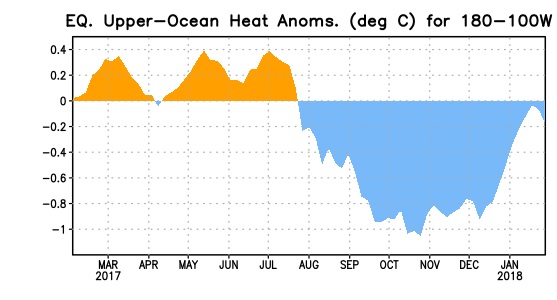
Return to El Nino expected by summer: NOAA. Expect more hurricanes.


The central Pacific was still cooler than normal in January, but it’s warming, and national climate experts say they are seeing clear signs of a returning El Nino by mid-year.

For Hawai`i, that potentially means drier conditions during the wet season, and more and stronger hurricanes during the hurricane season.

(Image: This chart shows how water temperature at the Pacific equator differed from normal over the past year. The big blue area at right represents the cooler water associated with the La Nina that seems to be ending. Credit: NOAA.)

The warming trend was documented in the latest report today (Feb. 8, 2018) from the Climate Prediction Center, National Centers for Environmental Prediction, National Weather Service and the International Research Center for Climate and Society.

The report confirmed that, for now, La Nina conditions are still in place, which forecasts in Hawai`i wetter weather and fewer named storms. For the Mainland, it suggests warmer weather and less rain across the southern states and cooler temperatures and more precipitation across the north.

“The atmospheric conditions over the tropical Pacific Ocean… reflected La Niña, with suppressed convection near and east of the International Date Line and enhanced convection around Indonesia.  Also, the low-level trade winds remained stronger than average over the western and central Pacific, while upper-level winds were anomalously westerly. 

“Overall, the ocean and atmosphere system remained consistent with La Niña,” the report said.

But most of the climate models used in the tracking of El Nino-La Nina cycles predict the mild warming seen in January will strengthen through the next few months, leading to neutral conditions by the period from March to May, and to full El Nino conditions by fall.

The report says that the various computerized models that predict climate trends don’t all agree with the forecast, but that on average, they clearly suggest the warming trend.

The way in which La Nina and El Nino impact storm formation in the Pacific is complex. In terms of La Nina, here’s what NOAA said in a 2016 statement.

 “La Niña typically suppresses central Pacific hurricane activity by increasing the wind shear and causing an irregular sinking motion in the atmosphere, both of which suppress storms from forming and intensifying.”

That was in place during the 2017 hurricane season. There were actually more storms than normal last year—18 named storms, 9 of which were hurricanes—but most were weak and did not last long.

But during the last active El Nino, the Pacific was a hotbed for tropical cyclones big enough to get names. In the El Nino year of 2015, there were 26 named storms, of which 16 were hurricanes. Hawai`i was spared a direct hit that year.

It was the second most active hurricane season on record. The last time there was more hurricane activity in the Pacific was in 1992, the year Hurricane Iniki hit Kauai head-on.
This latest El Nino-La Nina climate report updates the one we published last month. 

© 2018 Jan TenBruggencate

Thursday, January 11, 2018

Wet La Nina winter shifting, to a stormy summer?


Hawai`i’s wettish winter could continue, as the current La Nina climate cycle is expected to last through the winter.

That’s the latest assessment (January 11, 2018) from NOAA’s Climate Prediction Center and the International Research Institute for Climate and Society.


Long-term prediction of climate cycles is problematic, but most climate models seem to suggest that we could shift into El Nino by mid-summer. If that holds true, it could result an more tropical storms and hurricanes later this year than normal.


La Nina and El Nino are two major climate cycles affecting weather conditions in the Pacific. La Nina has cooler water in the equatorial central Pacific and El Nino has warmer waters.

Generally, for Hawaiian islands, El Nino conditions are associated with dry winters and stronger and more frequent hurricanes June to November. La Nina—which we’re now in—tend to have fewer storms from June to November and wetter winters.

Have you noticed a lot of strong tradewinds recently? La Nina conditions are also associated with stronger low-level tradewinds.

The new report suggests that La Nina conditions continued through the end of 2017 and are expected to persist through the rest of the winter, while weakening. After that, conditions should drift toward a neutral condition for the spring. And the models seem to indicate a continued shift toward El Nino as the summer progresses.

El Nino/La Nina conditions don’t only impact the climate of the Pacific, but are also associated with rainfall and temperature patterns on the Mainland.

Based on the latest climate models, “The outlooks generally favor above-average temperatures and below-median precipitation across the southern tier of the United States, and below-average temperatures and above-median precipitation across the northern tier of the United States.”

Since central Pacific ocean water temperatures are a key indicator of El Nino and La Nina cycles, the climate agencies have computerized models that track where they think water temperature is going. There are many such models, but as shown below, most of them are showing water warming into the summer months.

The bottom line shows months in three-month periods. The dynamic average shifts from negative to positive temperatures in May-June-July (MJJ)


Forecasts of sea surface temperature (SST) anomalies for the Niño 3.4 region (5°N-5°S, 120°W-170°W). Figure updated 18 December 2017. Credit: NOAA.


© Jan TenBruggencate 2018


Figure 6. Forecasts of sea surface temperature (SST) anomalies for the Niño 3.4 region (5°N-5°S, 120°W-170°W). Figure updated 18 December 2017.


Figure 6. Forecasts of sea surface temperature (SST) anomalies for the Niño 3.4 region (5°N-5°S, 120°W-170°W). Figure updated 18 December 2017.


Wednesday, January 3, 2018

Rats detected at Lehua, four months after major eradication effort

Rat control team on Lehua. Credit: DLNR
Rats are back at Lehua, or more likely, a few Pacific rats survive after a major effort to eradicate them during the late summer.


Wildlife management teams were on the island yesterday to better understand the extent of the rat presence and to establish extensive bait and trapping measures in the area where they were seen. They have not abandoned efforts to completely eradicate invasive rats from the small island.

The Lehua rat control project is designed to remove a major predator of the many species of seabirds that nest on the small island north of Ni`ihau. The island has been populated by Pacific rats at least for the past century. It is a state seabird sanctuary.

Pacific rats prey on eggs and chicks of many species, and they also damage the environment by eating seeds and seedlings of plants that otherwise would provide cover and nesting habitat for the birds.

This statement about the rat control project was released yesterday by the state Department of Land and Natural Resources:

Lehua's steep terrain. Credit: DLNR
“The invasive Pacific rat is a voracious predator on the eggs, chicks and even adult birds that currently breed and nest on remote Lehua. The restoration project team has stated repeatedly that the project will not be considered a success unless every invasive rat is removed from the ecosystem, and that will take a full year after the final application to say for sure. The goal of the Lehua Island Restoration Project is to provide safe, predator-free breeding habitat for native seabirds and other species so they may thrive again.”

Numerous motion detection cameras and human surveys of the island after the final delivery of diphacinone rat bait in September 2017 detected no rat presence. But camera memory cards collected in December revealed at least two rats near the summit of the island in late November.

The rats spotted on the camera cards are believed to be Pacific rats, the species that was abundant on the island before the eradication effort in August and September, although a positive identification from fuzzy black and white photos was not possible.

The team sent to the island yesterday included members from Island Conservation (IC), the state Division of Forestry and Wildlife and the Kaua‘i Endangered Seabird Recovery Project (KESRP.) 
The teams have installed a range of measures to attempt to assess whether there are more of the predators present on the island. A total of 134 monitoring devices have been placed on the island, including traps, tracking tunnels with ink pads to detect footprints, wax chewing blocks, bait stations and motion-detection cameras.
Many of the cameras are aimed specifically at seabird nests and burrows as part of the KESRP program, but will identify rat presence as well.

Rats have been eradicated from dozens of islands around the globe, and most eradications work the first time. However, a significant percentage has required repeat control efforts. In the case of Lehua, one theory was that winds at the top of Lehua blew rodenticide pellets away from the top of the ridge, allowing a few rats to survive there, while rodents elsewhere on the island were controlled.

“After seeing these two rats on camera, we collected, immediately reviewed, and noted locations of any additional images the cameras may have picked up,” said Mele Khalsa, of Island Conservation. A review of all other camera records identified no other rat photos.

“While we are clearly disappointed to see evidence of two rats on the island, we are very lucky our partners (KESRP) were able to detect them. We knew from the beginning there was the possibility that a few rats could linger. Now it’s important to address this,” said Suzanne Case, chair of the state Board of Land and Natural Resources.

The rat eradication program has been intensely controversial, largely over the fear that toxic baits could impact the marine environment. Tests on fish found around the island immediately after the bait distribution could not show that the rodenticide was an issue, and tests on the livers of pilot whales that stranded on Kaua`i a month later showed no presence of diphacinone.

Since the two rat detections were in the central part of the island, the current effort should not impact the coastline of Lehua.


© Jan TenBruggencate 2017

Saturday, December 30, 2017

Sunscreen chemicals may harm corals, but they're the tiniest player among reef threats


The dangers of certain sunscreens to coral reefs are believed by some Hawai`i legislators to be so dangerous that they are considering banning it.

Can they really be that bad? If they were, wouldn’t reefs where nobody swims be far healthier than those frequented by oil-slathered masses?

In our review of the science, it’s true that some of the chemicals in some sunscreens are harmful to reef organisms.

But as usual, this issue is complicated. 

While there has been much breathless prose arguing the hazards of sunscreens on reefs, there is also another side to this story. The other side is, essentially, that it is an issue, but a very minor one compared to the other challenges.

Also, even though folks worried about certain sunscreen products recommend using other products, some of those others may be dangerous to reefs too. And still more may use compounds that have not yet been thoroughly tested.

A 2008 research effort by Italian scientist Robert Danovaro argues that sunscreens can promote viral infections in tiny algae called zooxanthellae, and that can cause coral bleaching. Danovaro’s team looked at various components of sunscreens and found that in the laboratory, these had the strongest impact on coral bleaching: butylparaben, ethylhexylmethoxycinnamate, benzophenone-3 and 4-methylbenzylidene camphor.

Another of the key studies on the subject was published last year in the Archives of Environmental Contamination and Toxicology. The lead author was Craig Downs. It found that if certain corals were exposed to the active ingredient in many sunscreens, oxybenzone or benzophenone-3, they could harm corals and cause coral bleaching.

Oxybenzone is one of the chemicals in many sunscreens that shields your skin against ultraviolet radiation from the sun. And that reduces skin cancer risk.

Researchers found that if you expose coral cells to enough oxybenzone, it will kill them. At lower levels it will deform them, and will cause reef corals to expel their food-giving algae. When the algae are gone, the corals go white, a process called bleaching. Eventually the coral polyps can starve and die.

The study found that there can be impacts on coral larvae and cells at oxybenzone concentrations in the higher ranges found on Hawai`i beaches—notably heavily populated O`ahu beaches.

Thus, the authors wrote, “Oxybenzone poses a hazard to coral reef conservation and threatens the resiliency of coral reefs to climate change.”

But there’s more to it than that. 

We’re still waiting for studies that link the health of reefs where there is a lot of sunscreen-drenched swimming compared to similar reefs that are pristine.

Coral reefs are being hit by all kinds of attacks, and coral reefs are bleaching in the Main Hawaiian Islands as well as in the Northwestern Hawaiian Islands, many of which are uninhabited and sunscreen-free.

Hawai`i is taking coral reef degradation seriously. Earlier this year, the Department of Land and Natural Resources released its Coral Bleaching Recovery Plan. It focuses on a number of reef threats, primarily warming waters.

It does not consider sunscreen issues.

That doesn’t mean sunscreen is invisible to the state. The state Division of Aquatic Resources has issued a statement of concern that “Researchers have found oxybenzone concentrations in some Hawaiian waters at more than 30 times the level considered safe for corals.”

Rather than slathering on sunscreens with oxybenzone (read the label), the state recommends other alternatives to prevent sunburn: “water resistant sunscreens, which are more likely to stay on your skin, and sunscreens that use mineral filters, such as zinc oxide or titanium dioxide. Also, rash guards or wet suits will reduce the area of exposed skin, and thus the amount of sunscreen needed for protection.”

But switching to any other sunscreen may not be the best answer. It depends on which one. Zinc oxide and titanium dioxide are also potential reef problems. This study suggests that titanium dioxide, as it breaks up in the marine environment, can be toxic to marine algae. Zinc oxide is believed to have similar impacts.

If you care about reefs, limiting your participation in adding harsh chemicals to the surf is important. But you should also be paying attention to some of the more serious threats to reefs—including climate change, sedimentation from the land and overfishing. 

This 2012 study looked at all the known causes of a 27-year decline in coral cover on the massive Australian Great Barrier Reef. None of them was sunscreen. 

The big culprits, after tropical cyclones, crown-of-thorns starfish and climate-related bleaching: “their high sensitivity to rising seawater temperatures, ocean acidification, water pollution from terrestrial runoff and dredging, destructive fishing, overfishing, and coastal development.”
 
© Jan TenBruggencate 2017