Tuesday, December 6, 2022

Volcanic pyrotechnics: Mauna Loa is back


It’s been a while since the night sky over the highest parts of Hawai’i Island were lit bright orange by something other than the sun.


(The image above, an aerial USGS photo taken early Dec. 6 by L. Gallant, displays fountains at Mauna Loa Fissue 3. The fountains are running at 40 meters on average, with bursts to 100 meters.)

The new eruption of Mauna Loa is filling those skies—and the internet—with stunning shots of blazing fountains, glowing clouds and sinewy Halloween-colored lava flows.

Mauna Loa took a pause after its two-volcano show with Kīlauea in 1984. It was a long pause by Mauna Loa standards. The big volcano—the biggest one in the world—has erupted every five years or so since the early 1800s, and once every 6 years over the last few millennia. So a 38-year quiet is quite something.

There used to be arguments among volcano folks about whether the underground plumbing made it even possible for Mauna Loa and Kīlauea to erupt at the same time. They did in 1984, and again now, so that’s settled. They generally do not erupt together, but they can.

The new mystery is whether it’s possible for Mauna Loa, Kīlauea AND the younger volcano Kama’ehuakanaloa to erupt at once. As far as we know, that has not yet happened.

Kama’ehuakanaloa, formerly known as Lō’ihi, lies in the waters 20+ miles east of Nā’alehu. It is not currently erupting, although occasional swarms of earthquakes show that there’s magma moving under that seamount. We’ll see.

And might it be possible for concurrent eruptions of those three plus Hualalālai, which last erupted in 1801, and isn’t done yet. Mauna Kea and Haleakalā eruptions are also possibilities, but all three seem to be geologically napping at this time.

Mauna Loa’s eruptive phases tend to be big shows, but short ones. They range from a few days or weeks to as much as a year. That’s short compared to Kīlauea’s, which can go on for decades, but which produce far less lava.

Mauna Loa’s flows can run to the sea very quickly down sloping ground, depending on the direction they take. During the past two centuries they have reached the shoreline in North Kona, South Kona and Ka’ū, and made it to the outskirts of Hilo. Mauna Loa flows have reached from the eruption site to the coast, tens of miles away, in as little as a few hours.

That’s not happening right now, largely because the 2022 eruption is currently flowing into the flattish lands of the saddle between Mauna Loa and Mauna Kea, but if the eruption continues, and the lava spills out into steeper slopes, it could get moving pretty quickly.

As this is written, the hot lava is less than two miles from the old Saddle Road, now the Daniel K. Inouye Highway. If that cross-island artery is cut, disruptions for residents will be significant.

Mauna Loa’s lava production has been estimated at an estimated 100 cubic meters per second. (By my calculations, that would fill an average Hawai’i house every couple of seconds, an average apartment building every couple of minutes.)

 If you’re interested in this eruption, the National Park Service has an information site here, and it includes lots of links to other sources of information. 

© Jan TenBruggencate 2022

Wednesday, February 16, 2022

At Palmyra, native forests store more carbon than coconut plantations

There are lots of interesting things about native forests in the Islands, and The Nature Conservancy has just added an important one.

These forests do a better job of capturing carbon than planted forests, at least in the example of Palmyra Island, where the Conservancy and the U.S. Fish and Wildlife Service operate an atoll refuge a few hundred miles south of Hawai’i.

Native Hawaiian forests are excellent at capturing moisture and preventing aggressive, eroding runoff. That is in part due to the complexity of the Hawaiian forest. There are generally canopy trees, and smaller understory trees and shrubs and at the lowest level, ferns and mosses.

So when a heavy rain falls, its downward force is diminished by all the leaves and branches it encounters on the way down, and then the forest soaks it up like a sponge. So mountain streams in native forest areas run clear, not muddy. And they keep running even after weeks of dry weather, as the natural spongy forest floor lets the water seep out slowly.

By contrast, in a forest dominated by alien trees, like eucalyptus or Java plum, there is little understory growth. And heavy rains often lead to muddy runoff, eroded gullies, and sediment-filled streams. And shortly after the rain stops, the soils dry out.

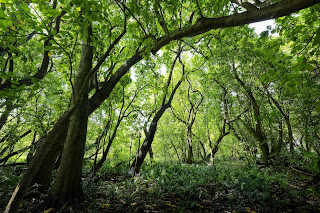
(Image at right: Pisonia forest at Palmyra. Credit: Andrew Wright.)


A new study at Palmyra by The Nature Conservancy has shown that another benefit of native forests is that they also store more carbon than single-species forests like the coconuts that once dominated Palmyra’s coralline ground.

The paper was published in PLOS One by Kate Longley-Wood, Mary Engels, Kevin D. Lafferty, John P. McLaughlin and Alex Wegmann. The title: Transforming Palmyra Atoll to native-tree dominance will increase net carbon storage and reduce dissolved organic carbon reef runoff.

At Palmyra, the Conservancy has been replacing dense coconut stands, which are not native to the island, and were planted to promote a copra industry, with the native forest that once existed there.  They knew there would be impacts of this conversion, but it wasn’t entirely clear what they would be.

“To better understand how this landscape-level change will alter the atoll’s carbon dynamics, we used field sampling, remote sensing, and parameter estimates from the literature to model the total carbon accumulation potential of Palmyra’s forest before and after transformation,” the authors wrote.

Their research showed that the new forest increased carbon storage on the atoll’s land areas by nearly 12 percent, and also reduced the flow of dissolved organic carbon into the island’s lagoon. That, in turn, is expected to result in healthier corals and a strong community of the species reliant on the coral reefs.

“We’ve demonstrated that better stewardship of natural resources can increase their carbon capture ability,” said lead author Kate Longley-Wood, Ocean Mapping Coordinator with TNC’s Protect Oceans, Lands and Waters program. “That native tree species are better for carbon capture and ocean health is the icing on the cake.”

All that said, it takes time for the effect to be seen, and the story will likely change somewhat over time as the restored forest matures. There is a loss of carbon in the standing trees when the coconuts are cut down and allowed to be replaced by native Pisonia grandis (Pu’atea in Tahitian or cabbage tree in English), Heliotropium foertherianum (beach heliotrope), Pandanus tectorius (hala or screwpine) and other species native to the atoll.

The native species are considered to be superior habitats for native seabirds, they store more carbon, and they support a larger native ecosystem.  But the results don’t mean it’s appropriate to go around cutting down all the coconuts elsewhere, as they could be important parts of the human communities on some islands. The scientific name of coconut is Cocos nucifera, sometimes written C. nucifera.

“C. nucifera’s role in human migration and settlement throughout Oceania is notable, and control of C. nucifera to transform native forest should be balanced with the societal value provided by C. nucifera to Pacific Island communities,” the paper said.

© Jan TenBruggencate 2022

Sunday, September 5, 2021

Re Covid, what you knew a few months ago is different now. Thank Delta variant and vaccines.


The pandemic is changing. What we knew a year ago is different now.

Here’s some of the latest.

This disease is now driven by the unvaccinated population. The unvaccinated are a minority of the population, but they dominate both all illness and severe illness requiring hospitalization.

An August 2021 study by the Centers for Disease Control of health care facilities in Los Angeles found that if you were unvaccinated, you were 5 times more likely to get the disease and 29 times more likely to require hospitalization for COVID.  

Young people seemed somewhat protected from the early strains of the virus, but that is changing.

“Rates of COVID-19–associated hospitalization among children and adolescents increased rapidly from late June to mid-August 2021, coinciding with predominance of the Delta variant,” the CDC reported.

(Children aged 12 to 17 are eligible for vaccination. Children 11 and younger are not currently eligible.)

Children are getting sick at higher rates than they were early in the epidemic, and unvaccinated kids are getting far sicker. Unvaccinated teenagers are 10 times more likely than those vaccinated to require hospitalization.

Among kids aged 0 to 17, “Emergency department visits and hospital admissions in a 2-week period in August 2021 were higher in states with lower population vaccination coverage and lower in states with higher vaccination coverage,” the CDC said

The changing dominant variant has changed the behavior of the pandemic. Where children were not particularly likely to get the Alpha variant, they seem more likely to get the Delta variant.

“Weekly rates of COVID-19-associated hospitalizations per 100,000 children and adolescents younger than 18 years old increased nearly five-fold, from 0.3 during the week ending June 26, 2021, to 1.4 during the week ending August 14, 2021,” the CDC said.

The data shows that among children, the youngest children are at increased risk.

“The sharpest increase during this period occurred among children aged 0-4 years, for whom the rate per 100,000 children during the week ending August 14, 2021 (1.9) was nearly 10 times that during the week ending June 26, 2021,” said the CDC.

© Jan TenBruggencate 2021

Friday, September 3, 2021

Vaccination against the Delta variant: the newest COVID-19 research

The Delta variant has upended the decline in COVID-19 numbers, but the most recent scientific reports indicate vaccination continues to be dramatically effective against it.

The disease is changing with new variants, and the science is changing as more and more researchers report data reflecting the new dominance of the Delta variant. We reviewed the latest scientific studies, which reflect the presence of Delta. The general conclusions are:

Delta is more capable of overcoming vaccination than Alpha or other variants.  That said, vaccination still provides remarkable protection—far more than half of vaccinated individuals will never experience illness with symptoms that make them feel sick.

❷ Vaccination will make you three times less likely to be infected than not being vaccinated. The COVID vaccines provide strong protection—better than the flu shot does against flu.

❸ Underlying medical conditions still increase the threat of severe infection requiring hospitalization, whether you are vaccinated or not, but vaccination improves your odds of experiencing few or no symptoms.

Here are some of the points in research published within the past three months. I have included hyperlinks so you can look at the original source material.

An Israel study showed that vaccination protection from the Pfizer vaccine dropped from 94 to 64 percent when measured against the Delta variant, the protection for the need for hospitalization only dropped from 97 to 93 percent. Meaning there was an increased chance you might get sick, but you were still extremely unlikely to get very sick. 

An India study similarly showed that while Delta gets through vaccination (which researchers call “breakthrough” infections) a little more effectively than other variants, most vaccinated individuals never get sick. 

An English study done from May to July 2021 found that during the study, earlier variants were completely replaced by Delta. And they found that unvaccinated people were three times more likely to get sick than the vaccinated. 

A Singapore study showed the mRNA vaccines, like Pfizer and Moderna, are extremely effective against the Delta variant. This study found that vaccinated patients who did experience breakthrough infections were much more likely to have no symptoms, while unvaccinated individuals were much more likely to get very sick. 

A Mayo Clinic study in the United States reviewed Moderna and Pfizer vaccines January through July 2021 confirmed that both were generally highly effective, but were less effective against Delta. That said, both are much more effective than the seasonal flu vaccine is against flu. 

A Canadian study found that all available vaccines provide significant protection against all variants. Single-dose vaccination provided some protection but full vaccination (2 doses properly timed) was far better. 

A BMJ (formerly British Medical Journal) article notes that vaccination provides good protection against infection, but that it provides excellent protection (in the 90+ percent range) against being so sick you need hospitalization. 

A Welsh-Scottish-Irish study found that vaccines provide similar or better protection than having actually had the disease. And even if you have had the disease, vaccination increases your protection against reinfection. “Effectiveness of two doses remains at least as great as protection afforded by prior natural infection,” the report says.  

The upshots are these:

Some vaccinated people will still get sick. That is the case with all vaccines--they are not 100 percent effective. As as case counts rise, you'll hear about more of these breakthrough infections, but that doesn't mean vaccines are not working.

All the newest evidence shows that vaccination makes you less likely to get infected with COVID-19, and that even if you do get infected, you are dramatically less likely be so sick that you’ll need hospital care.

Put another way, at this point in the pandemic, if you are not vaccinated,  you and your family are at dramatically higher risk of infection and severe illness.

© Jan TenBruggencate 2021

Monday, July 19, 2021

Your odds if not vaccinated are worse than drawing to an inside straight

Did you get the flu vaccine but not the COVID-19  vaccine?

How about that decision?

According to the Mayo Clinic

In the 2019-2020 flu season, 22,000 deaths among 38 million cases. Somewhat less than 1 in 1,000.

In the COVID-19 epidemic in 2020-2021, 580,000 dead among 32 million cases. Somewhat less than 2 in 100.

If you get the disease, you are 30 times more likely to die of COVID-19 than the flu. And these numbers don’t yet reflect the full impact of the new, more virulent Delta Variant.

Among vaccinated individuals, the death rate drops to less than 1 in 100,000, and most of those deaths are among frail, elderly folks in care homes.

Not getting vaccinated is betting on an inside straight. You might get lucky, but the odds are stacked way, way against it. Less than 1 in 10.