Showing posts with label Conservation. Show all posts

Saturday, December 7, 2024

For Hawaiian monk seals, a glimmer of hope

There were years when we despaired about the survival of Hawaiian monk seals. 

 Image: A young seal at Pearl and Hermes Atoll in the Northwestern Hawaiian Islands. Credit: NOAA Fisheries Hawaiian monk seal research program.


Populations were dropping year after year and nothing seemed to be able to turn that around. Take a look at RaisingIslands' 2008 post on the distressing status of seals at that time.

Now, a little hopeful news. It’s a slow process, but there has been a stabilization, and a tiny, steady increase in numbers for about the last 10 years. Over that time, up from just 1,400 to a current population estimated at about 1,600. 

That’s still only a third of what is believed to have been the stable healthy
population in the Islands, before they ran into humans. 

And right now, that increase is in spite of incidents of people shooting them, their getting hooked on fishing hooks, getting entangled in nets, picking up disease from land animals like dogs and cats, their Northwestern Hawaiian Islands pupping grounds disappearing due to ocean changes, shark attacks, and incidents of attacks by pet dogs. 

NOAA Fisheries in a 2022 release noted that the population had surpassed 1,500 for the first time in some 20 years. 

“From 2013 to 2021, the monk seal population grew at an average rate of 2 percent per year, providing hope for the species’ long-term recovery. Even so, the level required for the species to be down-listed from endangered to threatened under the Endangered Species Act is more than double the current number of monk seals,” the report said. 

It is an enormous task to care for the seal population. Federal officials and volunteers keep close watch on them. Sick and injured seals are regularly removed from the wild for hospital care. 

In November 2024 a malnourished pup from an O`ahu beach was transported to the Marine Mammal Center’s Hawaiian monk seal hospital, Ke Kai Ola, in Kona. 

In October a thin and weak pup from Lana`i and Maui was brought into care. 

In September, three malnourished pups from Pearl and Hermes Atoll in the Northwestern Hawaiian Islands were transported to the medical facility. 

In June, a Kaua`i pup suffering multiple infectious diseases was hospitalized. He was released back into Kaua’i waters healthy in late November. 

Occasionally, seals are relocated to move them from beaches with threats to beaches where they will be safer. 

The effort involves NOAA Fisheries, the Coast Guard, the Department of Land and Natural Resources, the Marine Mammal Center and lots of volunteers

Hawaiian monk seals, the most endangered seal species in the world, are found in the Main Hawaiian Islands, the Northwestern Hawaiian Islands and on Johnston Atoll, which is about 700 miles southwest of O`ahu. 

If you see a seal in trouble, you can email pifsc.monksealsighting@noaa.gov. Or call the Pacific Islands NOAA Marine Wildlife Hotline at (888) 256-9840. 

Here is a NOAA Fisheries resource page for more information about Hawaiian monk seals. 

© Jan TenBruggencate 2024

Wednesday, December 4, 2024

`Alala, Hawaiian crows, are flying free on Maui

Two ʻalalā. Credit: DLNR

The ʻalalā, the Hawaiian crow, is flying free again in a Hawaiian forest for the first time in years.

Five young birds have been released into the Kīpahulu Forest Reserve on Maui. For now, the birds seem to be staying close to the release site, and will be provided with supplemental food until they develop their foraging skills.

ʻAlalā were once found on several Hawaiian islands, but into the last century, the last place they were located was on Hawai`i Island. A plummeting population prompted an intensive effort to protect the species by bringing a few survivors into captivity.

Surviving birds were moved to Maui, and the captive flock was developed through a joint program of the Maui Forest Bird Recovery Project (MFBRP), San Diego Zoo Wildlife Alliance (SDZWA), and the U.S. Fish and Wildlife Service, along with the DLNR Division of Forestry and Wildlife (DOFAW).

Early efforts to re-release them into the wild on Hawai`i Island ran into problems, like crow predation by the also native `io, or Hawaiian hawk. The `io is not currently found on Maui, so wildlife officials hope the ʻalalā will better thrive there.

It has always been the goal to see ʻalalā return to the wild, not only for the birds, but also for the forest. They can play a key role as seed dispersers.

“We understand how valuable ʻalalā are as a cultural resource as well as a biological resource, said Martin Frye, research field supervisor for MFBRP. They play a huge role in Hawaiian culture just as much as they do in the Hawaiian forest. Those two things are linked.

The five birds selected for the release are young, as young crows are less territorial and are expected to be more gregarious than older birds. They are three males and two juveniles

They will have automated feeder boxes available to them, which will distribute food on demand. The birds are fitted with tiny backpacks that contain Global Positioning System transmitters, which will permit tracking them.

“Our focus is currently on closely monitoring these birds to ensure they have the best opportunities to thrive in their new home in east Maui,” said Chelsie Javar-Salas, supervisory U.S. Fish and Wildlife Service biologist for the Pacific Islands Fish and Wildlife Office.

ʻAlalā are remarkably intelligent birds, but these youngsters are several generations separated from the wild, so they will need to learn to forage and survive.

From a December 4, 2024, press release: “Success for the project relies on how the birds manage to adapt to their new home and can only be measured over time. The field team will continue to monitor the birds into the foreseeable future, supplementing their food and keeping an eye on their health and wellbeing. For now, the birds are free to roam and explore their surroundings, learning and feeling what it means to be wild.”

© Jan TenBruggencate 2024


Saturday, October 5, 2024

Anti-disease forest fungi thrive when they can hear their neighbors: a lesson in diversity


There is such value in diversity.

We can take a lesson from a new bit of science that suggests that life performs better when surrounded by its community.

This study found that certain fungi grow faster—many times faster—in an environment that includes sound, even if the species itself does not make sounds.

In the soil, if you were to insert a sensitive microphone, you would pick up the rustle of ants, the scuffling of scurrying beetles, the whisper of larvae, the swooshing of earthworms on their liquid missions and the motion of all the other critters that normally occupy a healthy underground environment.

Fungi don’t have ears, but from this study, clearly they can sense the presence of other creatures by the impacts of their movements, and you could anthropomorphize that they appreciate the company. They certainly behave as if they do.

This particular study was published in the journal Biology Letters. It was reviewed in the New York Times here. 

Wrote Times writer Veronique Greenwood: “Playing sound to Trichoderma harzianum, a green microscopic fungus that defends tree roots from pathogens, led to growth rates seven times as fast as those of fungus grown in the sound of silence. If the laboratory findings can be replicated in nature, then sound could be an unexpected new tool for improving the health of forests, encouraging beneficial microbes to take root and thrive.”

In this case, the researchers just played white noise for the green fungi, and saw dramatic increases in growth compared to the fungi grown in silence.

And here’s a leap.

A totally other piece of science, from the 13 September 2024 issue of Science magazine, expressed concern that the survival of Asian forest trees that contain anti-cancer properties is threatened. People are going into the forest and harvesting the trees to rarity and endangered status.

“Without these trees, cancer patients will lose access to a vital treatment,” wrote authors Gao Chen, Xiang-Hai Cai, Jia Tang, Guillaume Chomicki and Susanne Renner.

In Hawai’i, we have seen the impacts of loss of diversity. If you lose a pollinating bird species, you risk losing the plants they pollinate, and then the insect and fungal communities that rely on those plants. Round and round it goes.

Back to the fungus study, researchers aren’t sure how the fungi are sensing the sound.

“The mechanism responsible for this phenomenon may be fungal mechanoreceptor stimulation and/or potentially a piezoelectric effect; however, further research is required to confirm this hypothesis,” wrote authors Jake M. Robinson, Amy Annells, Christian Cando-Dumancela and Martin F. Breed.

But it was clear that in the presence of sound—all other things being equal—this little green fungus, Trichoderma harzianum, produces lots more biomass and also produces more spores, than in silence.

And they give back to their forest community. These little life forms colonize tree roots, and then protect the trees from disease and rot-causing fungi. They’re so good at it that they’re used as a natural fungicide—applied to leaves, seeds and the soil around valued plants.

Nature’s message is that a diverse community is a far healthier, more productive one.

© Jan TenBruggencate 2024

Saturday, September 21, 2024

John J. Berger''s new climate book: A comprehensive approach to saving the planet

 The top-of-mind responses to the climate crisis tend to be few and simple.

Use less fossil fuel and switch transportation to electric vehicles, restore forests, recycle, eat less meat.

But a serious response requires a broad rethinking of everything about how we live on the planet. And that’s complex.

John J. Berger’s new book runs through a lot of the approaches that are already underway and makes recommendations for how to proceed. The book is Solving the Climate Crisis: Frontline Reports from the Race to Save the Earth.

Berger is the author of Climate Myths, Beating the Heat, Forests Forever and more. He is a noted environmental writer and climate policy expert, and in his latest book he conducts a comprehensive review of strategies to address our warming climate.

Some possible solutions are underway right now or at least starting. Manufacturing steel that doesn’t depend on massive fossil fuel inputs. Replacing oil-based products with ones made from plants. Electric and fuel cell aircraft.

There’s green concrete, new approaches to recycling, buildings that produce more power than they use, hydrogen cargo trucks and so much more.

There are examples of farmers who have turned problematic fossil-fuel-reliant businesses into thriving green enterprises that restore the soil and entrain carbon. He outlines the benefits of saving and expanding forests.

He reviews some of the geoengineering approaches, like sucking carbon out of the atmosphere, and seeding the skies with compounds that reflect solar radiation.

He takes a realistic look at the issues associated with decarbonizing planet-wide.

There’s clearly lots to be done at the legal, policy and international affairs levels, Berger writes. His to-do list starts with a national recognition that we are in an emergency, and that we need a National Clean Energy Transition Plan.

But it would all be so very costly, right? Maybe not.

“Various studies have found that a clean-energy transition would cost no more than 2 percent of gross domestic product in the United States,” Berger writes. He says he worries about the accuracy of those estimates, but even so, “that’s a pretty good deal, given all the other economic, environmental, and health benefits the United States would also receive.”

Berger’s book is a little overwhelming in its scope, but it’s well-written and anyone interested in how we need to approach this crisis will find lots to chew on. That, and some hope. It may be complicated, but it's possible, is Berger's message.

It does occur to me that, given the topic of the book, an actionable strategy for Berger would have been making the ebook dramatically less expensive than a paper copy of the book, but it’s close to $20 for the electronic version. Here, here, here and here are a some ways to find Solving the Climate Crisis.

© Jan TenBruggencate 2024

Monday, September 9, 2024

Biological control for Coconut Rhinoceros Beetles?

 Researchers across the world are looking for some kind of bug or disease that can control the coconut rhinoceros beetle, (CRB).

Beetle infestations elsewhere were controlled a few decades ago with the release of a biocontrol virus called Oryctes rhinoceros nudivirus. But in Hawai’i we have a new strain of CRB that seems to be resistant to that virus.

Hawai’i’s biotype of the beetle, also found in Guam and some other Pacific areas, is called CRB-G (clade 1.)

As scientists scramble to look for predators, parasites or disease that might help, research is now focusing on a fungus called Metarhizium, which, when it is effective, kills the CRB beetle larvae and then covers the beetle larva with white fuzzy hairs that later turn green.

There is still more work to be done, but “biopesticides containing Metarhizium spp. are the strongest candidates for inundative biological control against the emerging CRB threat,” said this paper, which will be published in the November 2024 issue of the journal Fungal Biology.

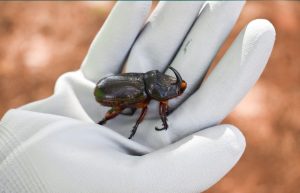
 (Adult CRB, image courtesy Hawaii Department of Agriculture)

That work is being done by researchers from Papua New Guinea, the Solomon Islands, Colombia, and New Zealand, and was funded by the New Zealand Ministry of Foreign Affairs and Trade.  The lead author of that paper is biocontrol researcher Laura Villamizar of AgResearch Ltd. in New Zealand.

One particular isolate of one species of the fungus, Metarhizium majus, appeared to kill CRB (S and G haplotypes) larvae within three to four weeks of application.

“Under field conditions, this isolate demonstrated its ability to infect CRB, dispersal up to 100 m from treated artificial breeding sites, and persistence in soil for at least four months,” the authors said.

That’s all good, but it is early research, and before a biocontrol can be released into a new environment, work needs to be done on what the unwanted impacts might be…like, does this fungus also attack the larvae of valued pollinating insects? 


 (Larval CRB, image courtesy Hawaii Department of Agriculture)

Meanwhile, we are approaching the infestation with conventional means.

This giant horned beetle is devastating Hawaiian coconut palms and threatens many other species. Entire coastal palm landscapes on O’ahu, where the beetle was first spotted in 2013, have been destroyed. The creature is actively spreading on other islands, having been identified on Kaua’i, Maui and Hawai’i islands.

The website of Coconut Rhinoceros Beetle Response has extensive information on the threat.

https://www.crbhawaii.org/

The beetle is known commonly as CRB, and science calls it Oryctes rhinoceros. The armored adult is up to two inches long and bores into the hearts of palms to feed on their forming leaves. The beetle larvae are the size of your thumb, and feed on decomposing plant debris—characteristically in compost and debris piles.

In addition to coconuts, they will go after other palms, including the threatened native loulu fan palms, as well as bananas, hala, kalo and sugar cane. Even some hardwood trees have been targeted.

Infected coconut palms are easily recognized by the jagged vee-shaped cuts in their fronds, caused by the feeding beetles when the fronds are still forming.


 (Adult CRB. Note the horn. For more info see https://dlnr.hawaii.gov/hisc/info/invasive-species-profiles/coconut-rhinoceros-beetle/. Image courtesy Hawaii Invasive Species Council.)

Control measures have include putting netting around the palms to block beetle entrance, and using insecticides. But for many palms and in many environments, neither is a feasible solution. (Some of the palms are too tall to realistically treat.) Furthermore, some insecticides can render the coconuts inedible.

Using attractants like pheromones in traps has been another approach. Here is a paper on the pheromone research done on the beetles. https://www.sciencedirect.com/science/article/pii/S0261219423002235

You will see pheromone-infused hanging insect traps at various locations around the affected islands.

 Here’s a trap system folks have used in Guam. https://www.youtube.com/watch?v=47ZQddcvFHk

There is a product called Palm Tree Weevil Killer, PTWK, which claims to be a non-toxic treatment that will kill beetles in the tree. We have not seen independent tests of this system and how well it works. Here are a couple of links: Link 1, Link 2. https://www.hawaiipalmguard.com/uploads/b/58101110-0675-11ef-8f26-0d8569411a43/d9f82fe0-1094-11ef-b96b-3ffeb1dc7cd9.pdf

https://www.alohatreesavers.com/our-product

© Jan TenBruggencate 2024


Sunday, June 9, 2024

Unique Hawaiiian farming system being revived: kalo growing in kukui mulch


While early Hawaiian agriculture clearly grew out of Polynesian farming systems, these islands developed a unique food-production structure quite different from those elsewhere in the Pacific.

Ethnobotanist and forest ecologist Noa Kekuewa Lincoln reviewed that uniqueness in a book chapter, “Pakukui: The productive fallow of ancient Hawaii,” printed in the book Farmer Innovations and Best Practices by Shifting Cultivators in Asia-Pacific.

Kukui (left) and Hala trees. 
Jan TenBruggencate photo.


“The Hawaiian Islands, one of the endpoints of Polynesian settlement of the Pacific, saw the development of unique agricultural advances that have not been seen anywhere else,” he wrote.

While flooded taro paddies (kalo,) hilled sweet potato fields (‘uala) and garden plots with sugar cane (ko) and fiber plants like wauke and mamaki are well understood, the importance of tree crops—agroforestry—has perhaps been overlooked, he argues.

“Although a robust literature and investigation of Hawaiian agriculture exists, arboriculture is severely underrepresented. This had led to a simplified understanding of Hawaiian arboriculture with an emphasis on permanent, breadfruit-dominated arboricultural systems.”

It may be that Western viewers look at agroforestry through shaded lenses, missing key features. For example, focusing only on foods, oils, medicines and fiber may miss key contributions of some tree crops, he suggested.

“In some regions, it may be that Hawaiians planted trees specifically to accumulate fertility. In these systems, very fast-growing woody plants that decomposed quickly, such as candlenut and hau, were cultivated,” he wrote.

Candlenut or kukui (Aleurites moluccanus) is and was an immensely useful tree, providing food for humans and livestock, oil for many purposes, dyes, medicine and much more

Less well understood is its value as a mulch. In a culture without Western fertilizers, mulches were of inestimable value. Mulches of kukui and other plants were stamped into the muds of kalo fields, where they rotted and improved fertility.

“In a recent experiment we grew taro in pure mulches of candlenut, sugar cane, and hau (Hibiscus tiliaceus), and the growth in candlenut mulch was by far the largest (by ~150%), despite it having the lowest nitrogen content of the three treatments,” Lincoln wrote.

Kukui leaves, branches and logs could also be used to create soils on solid lava. A mulch pit filled with kukui was called a pakukui.

“In these situations, litterfall was gathered into relatively impermeable pits in the lava and composted in order to create a growing medium. Local organic waste and small amounts of soil that could be excavated nearby was added to these enclosures, or pa, to aid in the rotting of composts.”

The system is similar to but larger than the manavai planting technique in Rapa Nui, where circular walls of stone protected small planting areas in rugged windswept environments. Manavai were also used for taro, as well as banana and sugar cane. 

The use of the pakukui led, Lincoln said, to a shifting agricultural pattern, in which farmers would be growing crops in some fields while other were composting. That contrasted with areas with breadfruit forests, which would be harvested year after year.

Kukui helped to make poorer soils much more viable for agriculture, though only for intermittent use. With the decline in Hawaiian population, the practice appeared to have died out.

“Following European contact in Hawaii, several forms of traditional agriculture rapidly declined, primarily due to the population crash that accompanied the introduction of foreign diseases. Among the practices that declined rapidly was the pakukui,” he wrote.

But the agricultural system still has value, and should be revived, he said. He is working with partners in Hamakua to convert “a long-established pasture back into a candlenut forest to reinitiate the practice of nutrient accumulation and natural fertilization to realize significant taro productivity.”

Lincoln works with Indigenous Crops and Cropping Systems in the Tropical Plant and Soil Sciences Department, College of Tropical Agriculture and Human Resources, University of Hawaii at Manoa. His pakukui chapter was published in December 2023.

© Jan TenBruggencate 2024