Showing posts with label Pesticides. Show all posts

Tuesday, April 22, 2025

Food safety in U.S. at risk from draconian budget and staff cuts

 The United States has the safest food in the world, but maybe not for long.

Massive cuts in the agencies that oversee the healthiness of our grocery store products are threatening the nation.

Food safety has long been protected by four major government offices: the DHHS’s Food and Drug Administration (FDA), the USDA’s Food Safety and Inspection Service (FSIS), the Environmental Protection Agency (EPA), and the Department of Commerce’s National Marine Fisheries Service (NMFS). Those agencies work together under dozens of interagency agreements to keep our groceries safe.

Food safety includes far more than just looking for toxic compounds and disease agents in food. There is safe packaging, sanitation in processing plants, pesticide residue testing, animal drug guidance, animal carcass inspections, checking for contamination from insect parts, all kinds of things.

State and local health departments play a role, but that role is widely different in differing jurisdictions. One of the main functions of those local authorities, often working with the federal Centers for Disease Control and Prevention, is investigating outbreaks after the food safety system has failed. Outbreaks like communicable diseases and foodborne pathogens like Salmonella, Shigella, Campylobacter, and E. coli

The broad consistent protections of the food supply come from the actions of the national government.

And the federal government is actively in the process of abandoning the safety of our food supply.

An April 10 White House memo disclosed plans to cut 40% from the budgets of the CDC and the National Institutes of Health (NIH). 

The DHHS is facing $40 Billion in cuts, a third of its discretionary budget. /

 Staffing cuts have already significantly cut services, and the FDA just announced that it will stop testing milk.

And the Administration laid off bird flu investigators at the FDA, while they were working on an active and spreading bird flu virus.

The EPA has been charged with cutting its budget 65 percent, although EPA Administrator Lee Zeldin says the environment will be protected even with the cuts. 

NOAA has been told to cut its budget 25 percent, and the NMFS (NOAA Fisheries) is looking at 28 percent.

A leaked White House document says FDA won’t be inspecting food processing any more, but that states will cover that under contracts from the FDA. 

"The budget eliminates FDA's direct role in routine inspections of food facilities," says the document. "FDA will expand the current state contracts for routine food facility inspections program to cover 100 percent of all routine foods."

But with the giant budget cuts, it is not clear from where will come the money to pay the states to do that.

Indeed, it is not clear how we can keep American food safe by cutting tens of billions of dollars and tens of thousands of jobs out of our food safety programs.

In a current case, a warning of slivers of metal in pork carnitas, it wasn’t government inspectors that discovered it. The FSIS put out the warning after the factory processing the carnitas identified the problem.

In another current crisis, there are four major listeria outbreaks underway right now, with more than 120 people sick at a dozen dead. That would be the FDA and the CDC, both of which are undergoing or facing severe staff reductions.

Food safety seems like something we’d want to support.

© Jan TenBruggencate 2025

Saturday, October 5, 2024

Anti-disease forest fungi thrive when they can hear their neighbors: a lesson in diversity


There is such value in diversity.

We can take a lesson from a new bit of science that suggests that life performs better when surrounded by its community.

This study found that certain fungi grow faster—many times faster—in an environment that includes sound, even if the species itself does not make sounds.

In the soil, if you were to insert a sensitive microphone, you would pick up the rustle of ants, the scuffling of scurrying beetles, the whisper of larvae, the swooshing of earthworms on their liquid missions and the motion of all the other critters that normally occupy a healthy underground environment.

Fungi don’t have ears, but from this study, clearly they can sense the presence of other creatures by the impacts of their movements, and you could anthropomorphize that they appreciate the company. They certainly behave as if they do.

This particular study was published in the journal Biology Letters. It was reviewed in the New York Times here. 

Wrote Times writer Veronique Greenwood: “Playing sound to Trichoderma harzianum, a green microscopic fungus that defends tree roots from pathogens, led to growth rates seven times as fast as those of fungus grown in the sound of silence. If the laboratory findings can be replicated in nature, then sound could be an unexpected new tool for improving the health of forests, encouraging beneficial microbes to take root and thrive.”

In this case, the researchers just played white noise for the green fungi, and saw dramatic increases in growth compared to the fungi grown in silence.

And here’s a leap.

A totally other piece of science, from the 13 September 2024 issue of Science magazine, expressed concern that the survival of Asian forest trees that contain anti-cancer properties is threatened. People are going into the forest and harvesting the trees to rarity and endangered status.

“Without these trees, cancer patients will lose access to a vital treatment,” wrote authors Gao Chen, Xiang-Hai Cai, Jia Tang, Guillaume Chomicki and Susanne Renner.

In Hawai’i, we have seen the impacts of loss of diversity. If you lose a pollinating bird species, you risk losing the plants they pollinate, and then the insect and fungal communities that rely on those plants. Round and round it goes.

Back to the fungus study, researchers aren’t sure how the fungi are sensing the sound.

“The mechanism responsible for this phenomenon may be fungal mechanoreceptor stimulation and/or potentially a piezoelectric effect; however, further research is required to confirm this hypothesis,” wrote authors Jake M. Robinson, Amy Annells, Christian Cando-Dumancela and Martin F. Breed.

But it was clear that in the presence of sound—all other things being equal—this little green fungus, Trichoderma harzianum, produces lots more biomass and also produces more spores, than in silence.

And they give back to their forest community. These little life forms colonize tree roots, and then protect the trees from disease and rot-causing fungi. They’re so good at it that they’re used as a natural fungicide—applied to leaves, seeds and the soil around valued plants.

Nature’s message is that a diverse community is a far healthier, more productive one.

© Jan TenBruggencate 2024

Monday, September 9, 2024

Biological control for Coconut Rhinoceros Beetles?

 Researchers across the world are looking for some kind of bug or disease that can control the coconut rhinoceros beetle, (CRB).

Beetle infestations elsewhere were controlled a few decades ago with the release of a biocontrol virus called Oryctes rhinoceros nudivirus. But in Hawai’i we have a new strain of CRB that seems to be resistant to that virus.

Hawai’i’s biotype of the beetle, also found in Guam and some other Pacific areas, is called CRB-G (clade 1.)

As scientists scramble to look for predators, parasites or disease that might help, research is now focusing on a fungus called Metarhizium, which, when it is effective, kills the CRB beetle larvae and then covers the beetle larva with white fuzzy hairs that later turn green.

There is still more work to be done, but “biopesticides containing Metarhizium spp. are the strongest candidates for inundative biological control against the emerging CRB threat,” said this paper, which will be published in the November 2024 issue of the journal Fungal Biology.

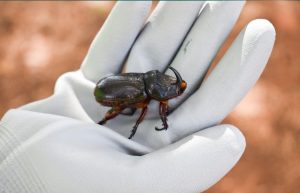
 (Adult CRB, image courtesy Hawaii Department of Agriculture)

That work is being done by researchers from Papua New Guinea, the Solomon Islands, Colombia, and New Zealand, and was funded by the New Zealand Ministry of Foreign Affairs and Trade.  The lead author of that paper is biocontrol researcher Laura Villamizar of AgResearch Ltd. in New Zealand.

One particular isolate of one species of the fungus, Metarhizium majus, appeared to kill CRB (S and G haplotypes) larvae within three to four weeks of application.

“Under field conditions, this isolate demonstrated its ability to infect CRB, dispersal up to 100 m from treated artificial breeding sites, and persistence in soil for at least four months,” the authors said.

That’s all good, but it is early research, and before a biocontrol can be released into a new environment, work needs to be done on what the unwanted impacts might be…like, does this fungus also attack the larvae of valued pollinating insects? 


 (Larval CRB, image courtesy Hawaii Department of Agriculture)

Meanwhile, we are approaching the infestation with conventional means.

This giant horned beetle is devastating Hawaiian coconut palms and threatens many other species. Entire coastal palm landscapes on O’ahu, where the beetle was first spotted in 2013, have been destroyed. The creature is actively spreading on other islands, having been identified on Kaua’i, Maui and Hawai’i islands.

The website of Coconut Rhinoceros Beetle Response has extensive information on the threat.

https://www.crbhawaii.org/

The beetle is known commonly as CRB, and science calls it Oryctes rhinoceros. The armored adult is up to two inches long and bores into the hearts of palms to feed on their forming leaves. The beetle larvae are the size of your thumb, and feed on decomposing plant debris—characteristically in compost and debris piles.

In addition to coconuts, they will go after other palms, including the threatened native loulu fan palms, as well as bananas, hala, kalo and sugar cane. Even some hardwood trees have been targeted.

Infected coconut palms are easily recognized by the jagged vee-shaped cuts in their fronds, caused by the feeding beetles when the fronds are still forming.


 (Adult CRB. Note the horn. For more info see https://dlnr.hawaii.gov/hisc/info/invasive-species-profiles/coconut-rhinoceros-beetle/. Image courtesy Hawaii Invasive Species Council.)

Control measures have include putting netting around the palms to block beetle entrance, and using insecticides. But for many palms and in many environments, neither is a feasible solution. (Some of the palms are too tall to realistically treat.) Furthermore, some insecticides can render the coconuts inedible.

Using attractants like pheromones in traps has been another approach. Here is a paper on the pheromone research done on the beetles. https://www.sciencedirect.com/science/article/pii/S0261219423002235

You will see pheromone-infused hanging insect traps at various locations around the affected islands.

 Here’s a trap system folks have used in Guam. https://www.youtube.com/watch?v=47ZQddcvFHk

There is a product called Palm Tree Weevil Killer, PTWK, which claims to be a non-toxic treatment that will kill beetles in the tree. We have not seen independent tests of this system and how well it works. Here are a couple of links: Link 1, Link 2. https://www.hawaiipalmguard.com/uploads/b/58101110-0675-11ef-8f26-0d8569411a43/d9f82fe0-1094-11ef-b96b-3ffeb1dc7cd9.pdf

https://www.alohatreesavers.com/our-product

© Jan TenBruggencate 2024


Wednesday, September 11, 2019

You have a pile of yard waste. How best to deal with it?


Walking stick, coulda been a bonfire.
So, youʻve got a pile of yard waste or pruned tree limbs. What to do with it?

1. You could use it; 2. You could let it rot (compost); or 3. You could burn it.

This is an argument for the first and the second, but not the third.

Some yard waste, if it doesnʻt have a bunch of weed seeds in it, can be mulch to keep weeds down and retain soil moisture. Or parts of it can be used as planting material (stick a plumeria stalk or a trimmed hibiscus branch in the ground and theyʻll grow). Chunks of wood can be slabbed up for construction projects, or carved into art objects. Really, you donʻt need to buy a walking stick...itʻs called a stick for a reason.

Composting is magical. It turns waste into a valuable soil amendment. And you can get all scientific about it to get the best, fastest results that produce enough heat to kill weed seeds. Or you can just pile the stuff up and the natural world will break it down in its own time. The crawly bugs and fungi and bacteria, the mesophylic and thermophylic organisms, the worms and the larvae, theyʻll do all the work.

What about the burning option? It gets the volume down fast, and creates wood ash, which has a lot of potash and other micronutrients that you could use in your yard.

There are times when burning is appropriate, but the downsides to burning are compelling. The heat sterilizes the soil under the fire and kills anything living in the greenwaste. If composting is a technique that celebrates life, fire is the opposite. Fire can be a natural process, but weʻre not talking about lightning-lit fires in native forests or savannahs.

(We can concede that for some species fire is a friend—grasses in many cases thrive after fires, both because the competition is killed off and because the ash fertilizes the soil. And we note in passing that a dry compost pile can sometimes catch fire, but thatʻs another discussion.)

What else?

Smoke from fires can be irritating to human (and other species) breathing and to eyes. It can make allergies worse. Sometimes toxic compounds that were locked up in the biological matter can be released into the atmosphere.

Wood smoke contains particular matter as well as chemicals in gas form. Breathing that stuff can have both short-term and long-term health impacts.

Hereʻs a paper on hazards of wood burning. And hereʻs a warning from the Centers for Disease Control and Prevention.

And then, of course, thereʻs the elephant in the room—the whole climate thing. Every time you burn, youʻre dumping a pulse of greenhouse gas into the atmosphere. Itʻs why folks are so exercised about the burning of the Amazon forests.

A few boring statistics: For every pound of wood you burn, you create 1.5 to 1.9 pounds of carbon dioxide (depending on the carbon density of the wood). Carbon dioxide, of course, is a big greenhouse gas. You also produce other greenhouse gases, like nitrogen oxides.

So to go back to the start, weʻre all better off if you make something (compost, mulch, a carved elephant, a picture frame) than if you immediately convert your woody waste to greenhouse gas. Youʻre just locking up that carbon for longer.

It seems clear that keeping that carbon in the soil rather than in the atmosphere is a good thing. And itʻs a good thing for more than just the climate, according to a 2005 article by Canadian researcher Henry H.Janzen. 

"Soil organic matter is far more than a potential tank for impounding excess CO2; it is a relentless flow of C atoms, through... myriad...streams—some fast, some slow—wending their way through the ecosystem, driving biotic processes along the way."

© Jan TenBruggencate 2019

Friday, November 30, 2018

Kauai pilot whale strandings punctuated by seven separate stranding incidents in a week down under


Dead pilot whales Kalapaki Beach. Credit: Author
Whale strandings—like the one that killed five pilot whales on an East Kaua`i beach last year--remain among the most mysterious of natural occurrences.

Kaua'i residents were traumatized the morning of Oct. 13, 2017, as glossy black pilot whales lay gasping on the sand at Kalapaki Bay. When well-meaning citizens shoved them back into deep water, most returned to the sand.

Boaters in canoes and power craft patrolled the bay, trying to keep remaining members of the pod from stranding. Eventually, five big whales were dead.

Seven strandings within the past week of more than 200 whales of several species in New Zealand and Australia has refocused attention on marine mammal strandings.

In all those southern hemisphere strandings, as in the Kaua`i stranding, the cause was not immediately apparent.

And in the Kaua`i case, despite intensive studies over a full year, scientists have been able to identify no obvious trigger.

"We still have no smoking gun but we're still looking," said David Schofield, stranding coordinator for NOAA's Pacific Islands Regional Office.

One of the Kaua`i animals, an older one, had signs of degenerative disease in earbones, but that was unlikely a cause of stranding, he said. One whale had about 10 pounds of marine debris in its gut, but that, too, was not a likely cause, Schofield said.

When animals are diseased, they are often malnourished. These whales weren't starved. There was fresh food in their bellies. There were no obvious signs of disease identified in a well-staffed mass necropsy that continued through the night of the strandings.

They weren't damaged by sonar: No sonar vessels were operating in the area, and in any case, the necropsies found none of the kind of inner ear damage caused by high-intensity sonar.

There were no signs of disease apparent within the first few weeks after the stranding.

Muscle and organ samples were sent to specialized laboratories, but tests for pesticides or rat killers like diphacinone were negative. (Diphacinone was of interest because it had been used in a rat control effort on Lehua Islet in the weeks before the strandings.)

Researchers are still working on laboratory studies of possible contaminants in the whale tissues, and tissue samples remain in storage.

"We keep the file open. As new science becomes available, we may go back and look again," Schofield said.

A series of seven separate strandings by different whale species in New Zealand and Australia—all within the past week--adds to the enigma.

Mystery is often the case in explaining whale strandings. And it’s just as much a puzzle this week in New Zealand and Australia.

Within the space of seven days, whales drove themselves on five separate New Zealand beaches from the North Island down to little Stewart Island, which lies south of Aotearoa's South Island, and even to the remote Chatham Islands, which lie in the Pacific east of New Zealand. And another two species died this week on the same beach, but in separate strandings in southern Australia.

Ninety pilot whales went ashore on the Chatham Islands today. An estimated 50 were dead or in such bad shape that wildlife officials euthanized them. A few were able to refloat themselves and may survive.

Four days earlier, 145 pilot whales went ashore on remote Mason's Bay on Stewart Island. They were the same species as in the Kaua`i 2017 stranding. All the Stewart Island whales died on a beach so isolated that it is only accessible by foot trail or by air. An aerial photo shows the one to two-ton whales scattered by the dozens along the shore, like so many akule drowned in a surround net.

On the North Island, 12 pygmy killer whales went ashore on one beach this past week. A few were reportedly pushed back into the water and may have survived, but at least half were dead. A sperm whale died on another North Island beach, and a pygmy sperm whale on still another.

Meanwhile, in Australia, 27 pilot whales and a humpback whale were spotted dead this week on a remote beach in Croajingolong National Park, which is in Victoria, the southernmost district on the Australian mainland.

They were spotted by air. By the time wildlife officials were able to get there, some of the pilot whales were still alive, but were so severely traumatized that they were put down. The humpback seems to have stranded earlier and was already dead, Australian wildlife officials said.

And once again, at this point nobody knows why. It is a long distance between these locations. From Stewart Island to the northern beaches of North Island is nearly 1,000 miles. From the Chathams in the Pacific to Victoria in the Tasman Sea is 2,000 miles.

There are lots of theories, many being proposed without evidence.

Folks looking for a common thread in the latest strandings have suggested climate change, but that's a guess. And it wouldn’t explain that the largest known stranding occurred a century ago. One thousand pilot whales stranded and died in the Chatham Islands in 1918.

The New Zealand stranding response organization Project Jonah, says it might be illness, parasites, pollution, injury from boat strikes, human undersea seismic work or sonar, disorientation due to shallow waters, boat noise, undersea volcanic or earthquake activity, and in some cases, simple geological traps—whales swimming into a bay a high tide an being unable to leave at low tide.

There is, in many of these cases, a kind of community unity. Once one whale is in trouble, the others stay in support—even at the risk of dying.

"Whatever the reason for the initial stranding, social cohesion may result in mass beaching. Their strong social bonds may prevent them deserting a helpless member. Going to their aid, these animals may then also become stranded themselves," says Project Jonah.

Strandings occur seasonally in some parts of the world, although not in Hawai`i. The stranding season is just beginning in the Australia-New Zealand area. Schofield recalls working Cape Cod, where there was also seasonality.

"In wintertime, when you saw certain tides, sea conditions and moon phase, you could almost predict them," he said.

And even so, the causes remain a mystery.

© Jan TenBruggencate 2018

Thursday, July 12, 2018

New study finds rat eradication improves fisheries around islands

Rat on palm. Credit Island Conservation, USFWS
If the rat eradication of Lehua Island ends up being successful, it could result in a more productive nearshore fishery.

Which is ironic, in that many of those fighting the eradication program were fishermen.

A new study in the journal Nature says that when rats kill off seabirds on islands, it means those birds are no longer pooping in the nearshore waters, fertilizing reefs. And that means fewer fish on those reefs.

This study was done in the Chagos Archipelago, where some islands have rats and others are rat-free. Researchers looked at both the fertility of the land on those islands and the productivity of their reefs, where erosion from the land would carry nutrients like bird-poop-sourced nitrogen.

The Chagos are atolls and reefs just south of the Equator in the Indian Ocean. Their ownership is disputed between Great Britain and Mauritius. One is Diego Garcia, which houses a U.S military base.

The results of the research were clear, said the authors, who are from Australian, British, Danish and Canadian research institutions.

On islands without rats, seabird density as well as nitrogen deposits were hundreds of times higher. Yes, hundreds: 250 to more than 700 times higher.

Those rat-free islands had reefs that had 48 percent more biomass of "macroalgae, filter-feeding sponges, turf algae and fish."

The researchers looked specifically at damselfish, and found that they both grew faster and had higher total biomass on the rat-free islands.

The theory, then, is that seabirds feed in the open ocean, deliver bird poop to the islands, and that the islands then feed the nearshore waters, which makes the waters more productive and capable of producing more fish.


"Rat eradication on oceanic islands should be a high conservation priority as it is likely to benefit terrestrial ecosystems and enhance coral reef productivity and functioning by restoring seabird-derived nutrient subsidies from large areas of ocean," the authors wrote.
Vampire mouse victim. Credit USFWS

Rats are not the only problems on islands. On Midway Atoll, near the western end of the Hawaiian archipelago, mice began eating seabirds after rats were removed from the islands there. The case of the vampire mice, which chewed into the necks of Laysan albatross, is reviewed here.

On other islands, the mice even seemed to be getting bigger on their diets of eggs and bird flesh. The Washington Post was among the many international publications that picked up the vampire mouse story.

All that said, rodents mainly go after eggs and chicks of nesting seabirds. That was the case at Lehua Island. Here is a description of the situation on the little island north of Ni`ihau before an application of a rodenticide to try to wipe out the rats.

"We found Wedge-tailed Shearwater and Red-tailed Tropicbird eggs broken open, the edges gnawed, the insides consumed. Tiny seabird chick bodies were commonplace–pulled out of burrows and half eaten. This was particularly true for the diminutive Bulwer’s Petrel–the vast majority of Bulwer’s Petrel burrows we found had bits and pieces of chick inside," wrote Andre Raine, Project Manager for the Kauai Endangered Seabird Recovery Project.


A couple of months after the 2017 rat eradication effort at Lehua, Raine said he could clearly see the difference:

"Fat, healthy Wedge-tailed Shearwater chicks shuffled about in their burrows looking like animated fuzzballs. One of our burrow cameras showed a Bulwer’s Petrel chick exercising outside its burrow and actually fledging – a great omen, as this is something we have never recorded on our cameras in previous years," he wrote.

Most, but not all the rats were killed off at Lehua, and wildlife crews were back this year with rat-hunting dogs to try to kill off the survivors and protect the island's nesting seabird population.

And the island's coastal reefs and fisheries.
The removal of rats from islands is a major conservation effort. It has been done successfully at islands in Hawai`i like Mokoli`i off O`ahu and Mokapu off Molokai. When it was accomplished at Palmyra Atoll south of the Hawaiian Islands, it had the unintended effect of killing off the disease-causing Asian tiger mosquito, which had depended on rats for blood meals. 

© Jan TenBruggencate 2018

Thursday, March 22, 2018

Vampire mice killing hundreds of Laysan albatross on Hawaiian island of Midway


Bloodied albatross. USFWS photo.
The mysterious vampire mice of Midway Atoll have left hundreds of adult Laysan albatross dead, their necks torn open in garish bloody wounds.

These mice are doing something no mice anywhere else in the world are known to do.

Late at night, they climb the necks of nesting seabirds and chew through the skin, apparently feeding on the birds’ blood, skin, fat and muscle.
The albatross’ commitment to protecting their eggs is so strong that they will shake their heads, but will not leave the nests even with a predatory rodent chewing on them.

And the problem has grown since it was first spotted in 2015.

Wildlife officials assess injured Laysan albatross. Credit: USFWS
“It is horribly destructive what they do to those birds,” said Matt Brown, the U.S. Fish and Wildlife Service superintendent for the Papahānaumokuākea Marine National Monument, which includes Midway.

The Fish and Wildlife Service has teamed up with a number of agencies and now hopes to eradicate the mice, which are an alien species to Midway. Among the 10 major atolls, reefs and islets of the Northwestern Hawaiian Islands, mice only occur on Sand Island, one of the three specks of dry land within Midway Atoll.

The mice have been here at least since World War II, but the new vampirish behavior is both new to Midway and apparently new to science. Mice are known to take eggs and nestlings of seabirds elsewhere, but only on Midway do they attack large adult birds.

“This isn’t a behavior that has been observed before, although rodents have been responsible for a number of seabird extinctions and extirpations on islands,” said Megan Nagel, public affairs officer for the Fish and Wildlife Service in Honolulu.
A Fish and Wildlife Service fact sheet quoted Midway Atoll Refuge manager Bob Peyton: “The Service is working against the clock to determine how many birds have been attacked, what the rate of spread is, and how to stop the attacks. Albatrosses lay only one egg a season.” 

The proposal they’ve come up with is to try to eradicate the mice. New Zealand just completed a successful five-year effort to remove mice from the Antipodes Islands, where they were feeding on chicks and eggs of seabirds, apparently including the Wandering Albatross, whose 10 to 11-foot wingspan makes it one of the biggest of birds. 

The Midway approach will be similar to the one used at the Antipodes: a helicopter drop of toxic bait pellets during a period when the nesting seabird population is at its lowest.  That’s also similar to the technique that has been used to remove mice from more than 80 other islands and to remove rats from more than 400 islands around the world.

In Hawai`i it’s much like the system that was used to eradicate Pacific rats from Mokapu Island off Molokai and black rats from Mokoli`i off O`ahu, and which has been used to control rats at Lehua Island off Ni`ihau, a process that is still underway.
Rats were eradicated from Midway’s three islets in 1996.

The environmental assessment for the Midway mouse effort, under the name Midway Seabird Protection Project, describes the issues and the proposed solution. The public comment for the environmental assessment is open through April 20.

The helicopter would achieve a uniform islandwide distribution of specially designed bait pellets that contain the anticoagulant Brodifacoum. Some hand distribution will be employed in sensitive areas such as near the shore. The work would be done in the summer of 2019, during a period when seabirds are comparatively scarce on the island, and when dry weather limits mouse food supplies—making the grain-based bait pellets more appealing.

There are a number of reasons to use a helicopter, including assuring an even bait distribution but also foot traffic in many areas would collapse many of the thousands of nesting burrows of Bonin Petrels, which recovered strongly after rats were removed.

Similar eradication efforts on other islands have usually but not always been successful. In recent years, the success rate has gone up with improvements in technique. The environmental assessment reviews alternative approaches, and looks at the option of doing nothing at all.  The Brodifacoum bait delivered by helicopter at the right time of year, in specific amounts over time, as described in the proposal, is viewed as the best alternative.

The project is estimated to cost $3.5 million. It is not yet clear the source of that money. Many previous eradications have been funded through a combination of government funds, grants from foundations, and money from private institutions like conservation groups.

The Fish and Wildlife Service would be the lead operational agency, with technical support and assistance from Island Conservation and the Midway Restoration Partnership Group. This is a collaboration of the Fish and Wildlife Serfvice and Island Conservation as well as American Bird Conservancy, the National Wildlife Research Center of the U.S. Department of Agriculture’s Animal and Plant Health Inspection Service, National Oceanographic and Atmospheric Agency, U.S Geological Survey and the state Office of Hawaiian Affairs.

© Jan TenBruggencate 2018
What's at risk :Midway albatross colony. Credit: USFWS.

Wednesday, November 15, 2017

Cool Hawaiian science: blend up some healthy leaves, spray on sickly plants, and create healthy plants


We are not alone, and we can’t be.

Whether human or plant or other species, we all live by John Donne’s rule: “No man is an Island, entire of itself; every man is a piece of the Continent, a part of the main.”

(Image:  The native mint P. kaalaensis in flower, with fungal
infection (white spots on leaves). Credit: Geoff Zahn.)

University of Hawai`i researchers, in an elegant new piece of work, show that even plants in the garden depend on a community of other organisms to protect them. Some of these natural allies live in the soil and root, in the stems and leaves, and even on the stems and leaves.

In this case, working with a native mint called Phyllostegia kaalaensis, professor Anthony Amend and researcher Geoff Zahn found that they could transplant disease resistance into a plant that otherwise was a severe risk of fungal attack.

The mint, which was once thriving in the wild, has been extinct in the wild since 2015. The ones still living in nurseries were extremely weak--perhaps because they were sprayed regularly with fungicides to prevent fungus attack. The fungicide kept them alive but also kept them weak, said Zahn.

As long as the plants remained so vulnerable, there was little hope of restoring them to the wild, where they would immediately be killed off.
Healthy native mint in the wild. Credit: Vincent Costello.

All it took was to blend up (actually blend, in a blender) the leaves of a related wild plant, which presumably contained whatever protective organisms lived with the wild plant. The donor plant was a related endangered Hawaiian mint from Molokai, Phyllostegia hirsuta. 

They sprayed the blended stuff onto nursery plants. And the plants that had been given this “transplant” of beneficial organisms were suddenly able to fight off fungal attack. The beneficial organisms are called endophytes, which are forms of life like fungi and bacteria that live inside the plant. 

Here’s now the University of Hawai`i press release put it:

“They took leaves from a closely related wild that plant was healthy and contained a typical mix of endophytes, blended them into a smoothie and sprayed the mixture onto the leaves of (the native mint)  to see if beneficial microbes could be transplanted from one species to another. They then subjected these plants, along with a control group, to the deadly powdery mildew. The plants that received the microbial spray were able to resist disease, those that didn’t receive the spray soon died.”

The research is simply remarkable. Nursery plants, generally planted in sterile media, are “alone.” They don’t have their natural biological communities around them. And as a result they are severely vulnerable. 

In this case, Amend and Zahn weren’t sure which of the constituents of the blended spray did the anti-fungal work, so they tested for it.

“Using DNA barcode sequencing to identifying which species were inside leaves before, during, and after the disease, Amend and Zahn determined the beneficial fungus that was most likely responsible for protection from disease: the yeast Pseudozyma aphidis. Those treated plants did so well, that they have since been planted out in the wild, and now represent the only wild population of P. kaalaensis on the planet.”

Zahn said this yeast can live both on the leaf surface and inside the plant's tissues. When they prepared the leaves for blending, they cleaned the exterior, so the protective fungus came from inside the tissues of the hirsuta. 

The National Science Foundation and the Army funded the research. Anend and Zahn were associated with the University of Hawai‘i at Mānoa botany department and the O'ahu Army Natural Resources Program. Zahn has since moved on to Utah Valley University.

Amend continues the work in Hawai`i, and also works with University of Hawai`i researcher Nicole Hynson, who is studying, among other things, beneficial organisms in the roots of plants.

This remarkable research builds on a growing understanding of the relationship between diverse life forms. 

Some years ago, researchers were able to save an exceedingly rare native orchid on Molokai.

The orchid did poorly in captivity, and did poorly when planted out in the wild. But when it was planted in soil that had been inoculated with soil from places where it had once grown, it did fine.

Growing with the soil organisms on which it depended, it survived. Alone, it did not.

We’re not even going to go here into the relationships between humans and their gut organisms. But whether you go by “no man an island” or “it takes a village,” the message is clear.


 © Jan TenBruggencate 2017