Saturday, December 10, 2022

Lose the mosquito, save the bird, save the forest.

 Haleakalā National Park hopes to launch a program to protect the park’s few remaining native forest birds from the ravages of avian malaria.

And maybe save our native forests in the process.

This mosquito-borne disease is a primary cause of the loss of our state’s stunning forest singers—all the green and gold and red and brown and slate feathered gems, with their flashing tufts and perky tails and dramatically curved beaks.

The combination of a new sterile mosquito technique and recent advances in drone technology mean this control program is something whose time has just come.

The park has released for public comment its environmental assessment, “Suppression of Invasive Mosquito Populations to Reduce Transmission of Avian Malaria to Threatened and Endangered Forest Birds on East Maui.”

It is available here, along with an opportunity to comment. (I’ll be clear: I have commented in favor of the program and strongly support it.) 

The proposal, in short, is to use drones to release sterile male mosquitoes that have been infected by a natural bacterium called Wolbachia. The males will outnumber natural males, and when they mate with females, no young are produced. That will reduce mosquito populations and presumably reduce new infections with avian malaria.

The Incompatible Mosquito Technique in this case would be aimed at the southern house mosquito (Culex quinquefasciatus), which is the only Hawai’i-resident mosquito to transmit avian malaria.

This disease has wiped out dozens of species of amazing Hawaiian forest flyers, many of which were specialized pollinators of rare native plants—so the entire forest dies with them.

The technique has been used elsewhere on other mosquito species to control diseases like dengue fever.

The World Mosquito Program reported earlier this year: “We have released Wolbachia mosquitoes to reach more than 10 million people (as of June 2022). In areas where Wolbachia is self-sustaining at a high level, notified dengue and chikungunya incidence has been significantly reduced.”

The World Mosquito Program reviews the technology here. https://www.worldmosquitoprogram.org/en/work/wolbachia-method

We’ve been talking about it in Hawai’i for several years. Talented writers Brittany Lyte and Nathan Eagle reviewed progress in Honolulu Civil Beat three years ago. 

The park has been holding public meetings on the program even before the draft environmental assessment was released. The environmental assessment comment period runs to January 23, 2023.

And to be clear, there have been lots of programs to control mosquitoes over the decades, and they have included various pesticides, repellents, genetic modification, fungi and now bacteria. Lots of older folks, me included, can remember running in clouds of DDT that were used to control insect pests a couple of generations ago.

How far we’ve come.

© Jan TenBruggencate 2022

Mauna Loa is like "Jaws." Something's moving below the surface. When will it rise?


(Image: Webcam shot at Mauna Loa's Fissue 3, taken this morning, December 10, 2022. Credit: USGS.)

The Mauna Loa eruption right now is a little like the movie Jaws: something's moving under the calm surface...when will it rise?

The eruption that started November 27 has stopped producing much lava. Its threat to the Saddle Road is, for now, abated. It's not fountaining any more. There's just a pond of lava at the Fissure 3 vent, which is spilling over into short, stagnating flows. Significantly less gas is being pumped out of the fissure.

But deep below, magma is still moving up into the upper reaches of the mountain. 

"Tremor (a signal associated with subsurface fluid movement) continues beneath the currently active fissue," the USGS reported this morning,

"This indicates that magma is still being supplied to the fissure and activity is likely to continue as long as we see this signal."

Yesterday, the USGS suggested the fountaining could return any time, Today, the scientists downplayed that possibility: "None of the eight recorded eruptions from Mauna Loa's Northeast Rift Zone returned to high eruption rates after those rates decreased significantly." 

So the magma is still rising underground, but it's not erupting. 

Hmm. Can you hear the "Jaws" drumbeat?

© Jan TenBruggencate 2022


Friday, December 9, 2022

Quiet on the Mountain: Mauna Loa in a pause? Not quite.


Things are pretty calm up on Mauna Loa, with the active fissure glowing, but not aggressively fountaining, and still apparently producing a little lava.

It will be some time before it is clear what's going on, whether this is the start of a pause in the Mauna Loa eruption, or the end of this event, or something entirely different.

"A return to high levels of lava discharge could occur," the USGS said in its Friday morning update.

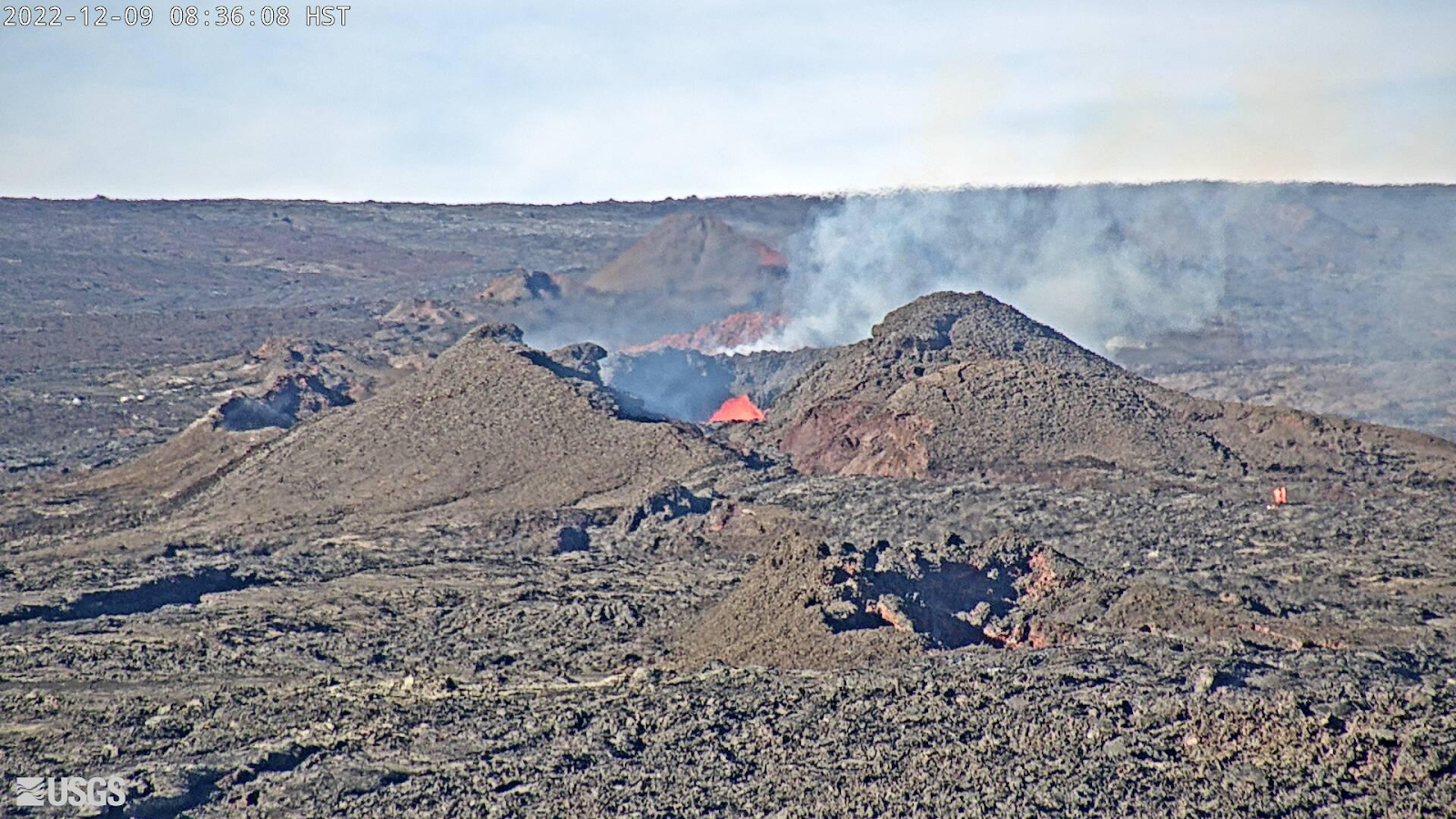
The image above is a USGS webcam view of Fissure 3, which until two days ago was pumping with high lava fountains and feeding a long flow that threatened the Saddle Road/Daniel K. Inouye Highway. The image was collected at 8:36 a.m. Friday, December 22, 2022.

There's still some glowing rock, but fountains are not visible in this image. The USGS update late Thursday indicated that the amount of lava had dropped significantly from Wednesday to Thursday. And this morning it reported that there was low fountaining that was feeding a small flow that goes a mile or so from the vent.

The long flow that got to within 1.7 miles of the highway is essentially stopped, although as it cools, it is spreading out a little.


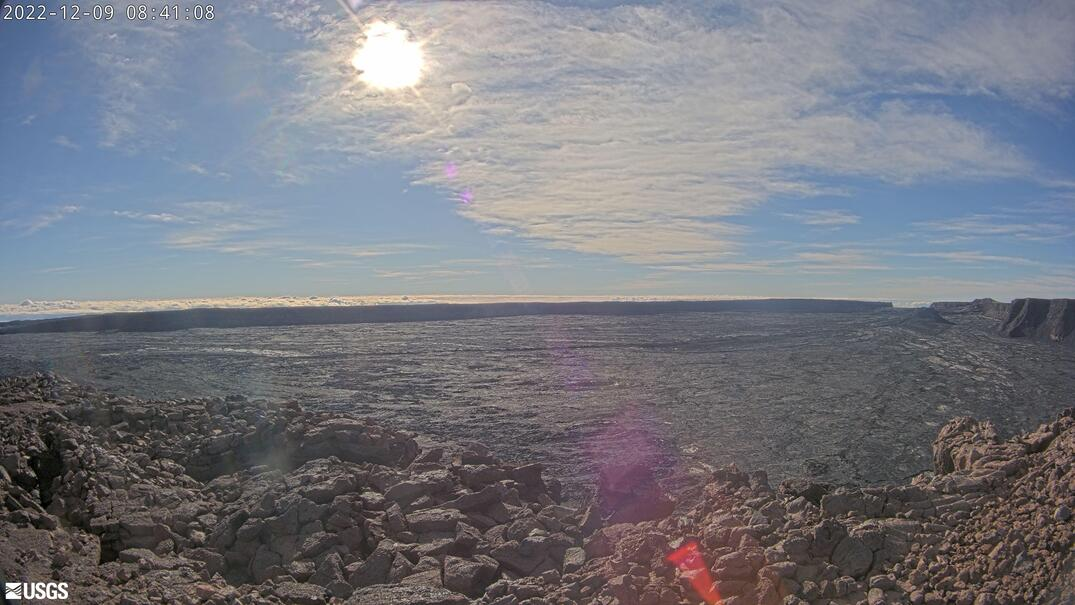
An image from a webcam a few minutes later overlooking Moku'aweoweo  indicated the summit caldera was similarly quiet.


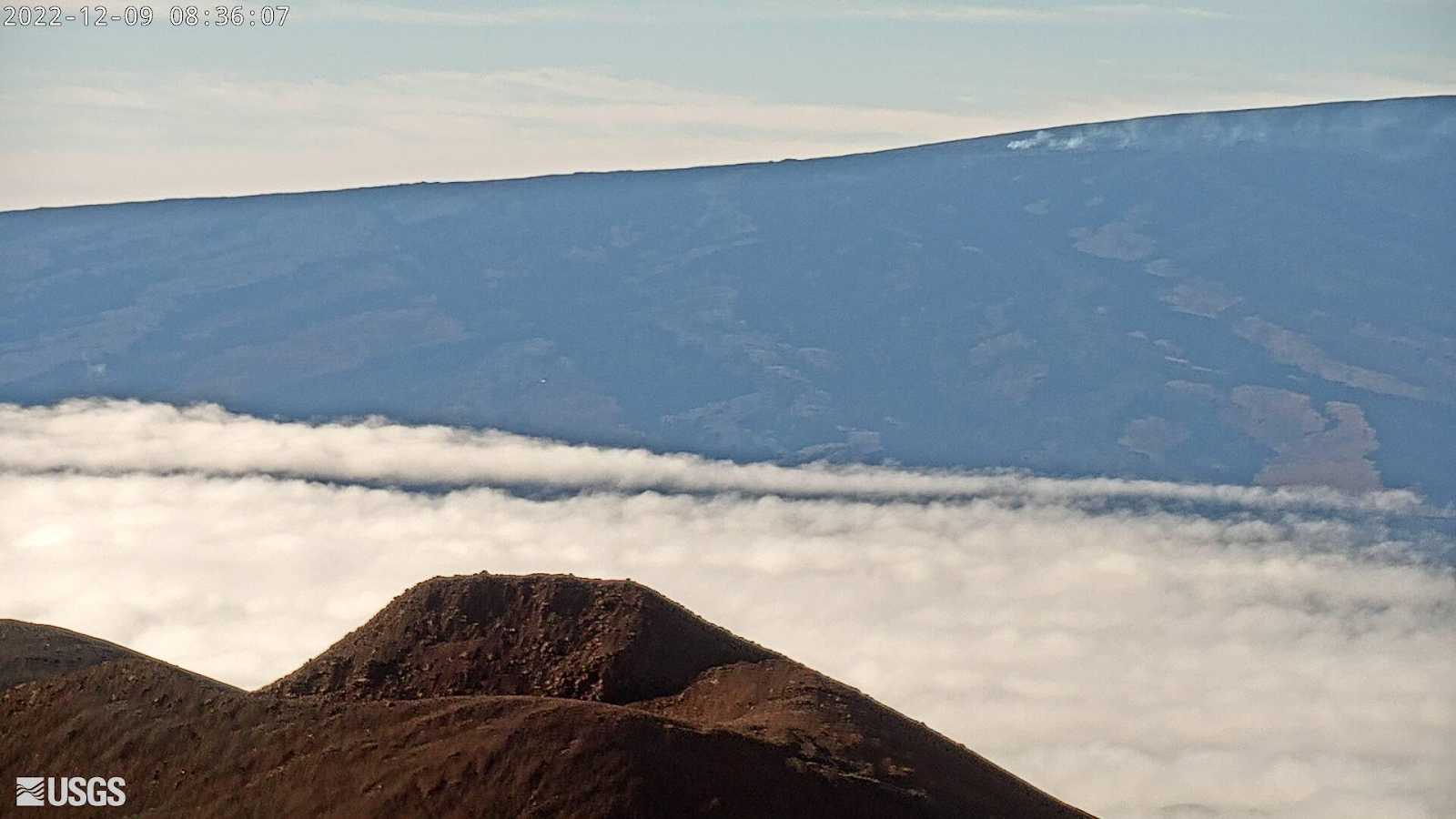
Another webcam shot from Mauna Kea, looking across to Mauna Loa at 8:36 a.m. shows smoke up on the Mauna Loa rift zone, but no fire.

View the webcam images yourself here.

What does it all mean? The Hawaiian Volcano Observatory scientists admit they're not certain.

"The significance of the reduced supply of lava is not yet clear; it is common for eruptions to wax and wane or pause completely," the USGS reported in its morning update.

It reported that there is still magma moving up into the mountain, as indicated by continuing tremor within Mauna Loa.


© Jan TenBruggencate 2022

Thursday, December 8, 2022

Mauna Loa eruption scaling back


The Saddle Road appears safe for now from being engulfed in lava.

Mauna Loa dramatically reduced its eruption lava volume overnight from December 7 to 8, and is no longer feeding the long flow that had threatened the Daniel K. Inouye Highway. The flow front is stalled and cooling about 1.7 miles from the highway. 

The USGS reported: "Lava is overtopping channels near the vent with flows extending no farther than 2.5 mi (4 km) from the vent. The channels below this point appear drained of lava and probably no longer feed the main flow front."

That said, tremor measuring the flow of magma under the volcano indicates there's still molten rock being fed to the mountain.

So what happens next? We'll see.

See the full USGS report here.

© Jan TenBruggencate 2022


Hurricane season 2023 could be more dangerous


Hurricane seasons have brought mild weather for several years now, and the latest forecast suggests that El Nino will not return, at least through April 2023.

But there seems to be roughly an even chance of El Nino conditions showing up for the start of the 2023 hurricane season—the summer of 2023.

Forecasting that far out is fraught, so the Climate Prediction Center’s latest formal forecast, issued December 8, 2022, does not carry all the way into the 2023 Hurricane season. But there are indications that the climate may be shifting in the direction of El Nino.

Forecasters predict a roughly 50% chance that 2023’s hurricane season will have El Nino warming conditions, which are associated with more and stronger hurricanes for the Hawaiian Islands.

For many months, we have been in a La Nina ocean condition, which reflects cooler mid-Pacific waters less likely to promote hurricane development. Today’s prediction suggests there’s an even chance that through April 2023—the non-hurricane season--it will remain La Nina or neutral.

That said, there are indications the climate could be swinging in a warmer direction.

“In November 2022, negative subsurface temperature anomalies weakened, reflecting an eastward expansion of the above-average subsurface temperatures in the western and central Pacific and contraction of the below-average temperatures across the eastern Pacific,” the CPC/National Centers for Environmental Prediction said in its El Nino/Southern Oscillation Diagnostic Discussion. 

El Nino conditions have warmer waters around the Equator in the Pacific, and are associated with more and stronger hurricanes in the Central Pacific.

© Jan TenBruggencate 2022